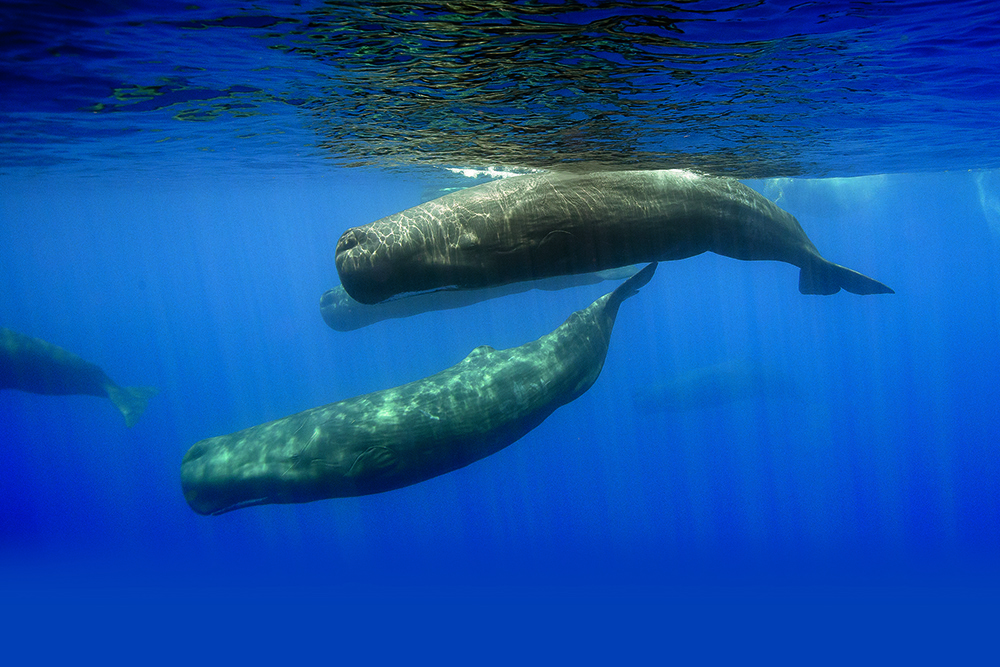



In comparison to baleen whales, toothed whales [Ed’s Note: toothed whales (also called odontocetes, systematic name Odontoceti) are a parvorder of cetaceans that includes dolphins, porpoises, and all other whales possessing teeth, such as the beaked whales and sperm whales.] have an ability to produce sounds not only for use in social communication and navigation (using whistles and burst pulses) but in a way that allows them to take ‘pictures’ of the world around them, including what is on the dinner menu (using echolocation click trains).
Air is moved through dedicated nasal passages in the head, forming clicks as it passes through the ‘phonic lips’, which act a bit like castanets. These clicks are then directed through that famous fat-filled organ known as the ‘melon’ that focuses the vibrations into a beam like a flashlight, but for sound waves. Using these specialised tissues, a wide variety of sound vibrations can be propagated to varying distances according to the animal’s desires.
The highly focused beams of clicks produced for purposes of echolocation (also known as ‘biosonar’) are an incredible information-gathering system that allows the animal to ‘see’ with sound, which is especially useful when much of the time the seawater is murky or dimly lit, if not pitch dark. The returning echoes of their ‘click trains’ are received by fatty tissue in the lower jaw, which then transfers information via the inner ears to the brain, giving them a mental image of their forward-facing view.
The accuracy of this sonic scanner is simply astounding, allowing the whale or dolphin to determine characteristics such as the shape, size, speed, distance and direction of the target, as well as aspects of the internal structure that can even reveal the difference between preferred prey species. By scanning objects with high-frequency biosonar, a dolphin can differentiate a ping pong ball from a golf ball based solely on the density differentials.