Back to Basics Part 6: Marina Handling

In Part 6 of our Back to Basics series, Paul Glatzel explains marina handling, twin-engine techniques and the practical APE approach to safer berth manoeuvres.
28 May

Edited May 28, 2024

Powerboat and RIB

Content by Paul Glatzel

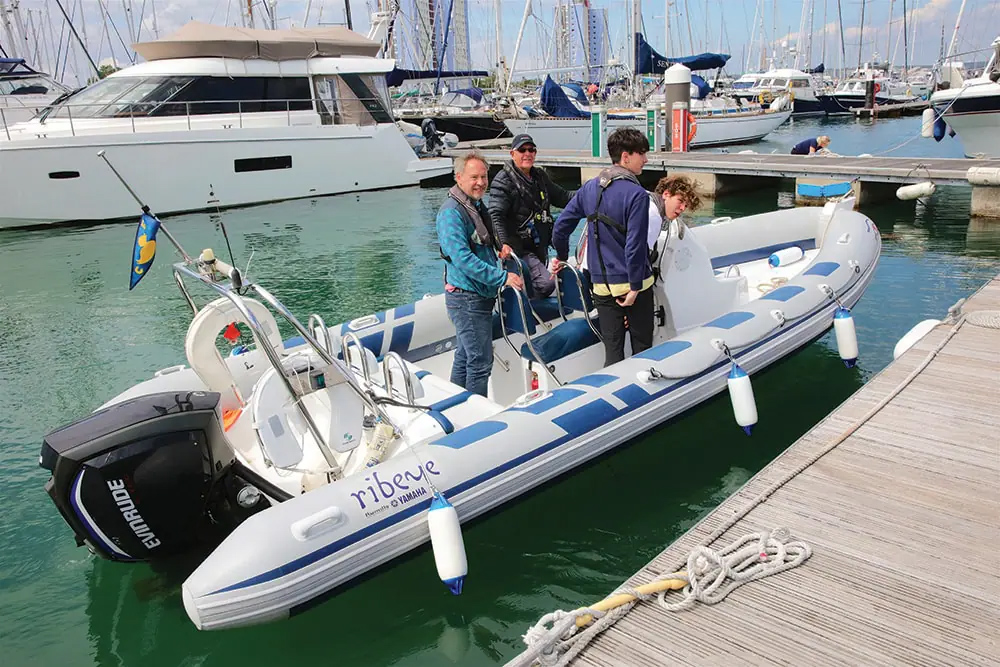
Crew practising marina berthing on a RIB with outboard engine, fenders deployed alongside pontoon docks

Share this Article

Twin-engine boat handling techniques in marinas

In the sixth part of this Back to Basics series of articles, Paul Glatzel offers advice on handling your craft within a marina …

Previously we’ve looked at the core building blocks of boat handling – how all powerboats react to wind, how to manoeuvre in wind and tide, and how to turn in a small space. We started by looking at these aspects with a single-engine craft, but what about a twin-engine set-up? How does that affect things? And how do we put these skills into practice in a marina situation?

Let’s start with the question of twin-engine handling. With a single-outboard or outdrive/sterndrive set-up we’ve previously addressed the subject of ‘steer then gear’ as getting the steering where we want to go before engaging drive to have the most pronounced effect. If you have a twin set-up, you have a choice as to how you choose to handle the vessel. If we are teaching on a twin-outboard/outdrive craft, we’ll always focus on sticking with the ‘steer then gear’ approach – at least until the skills for this method of handling are well bedded in. We’ll teach students to use one engine at a time, employing the one that has the greatest effect/leverage. So, if turning left (ahead or astern), you should use the right-hand engine with the helm over in the required direction. If turning right, use the left engine.
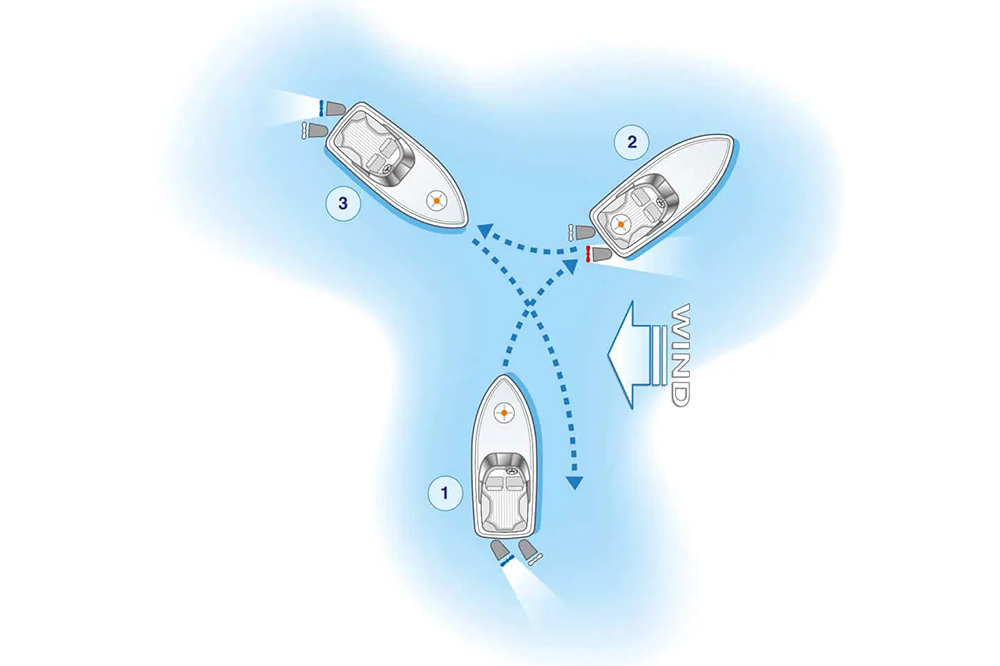
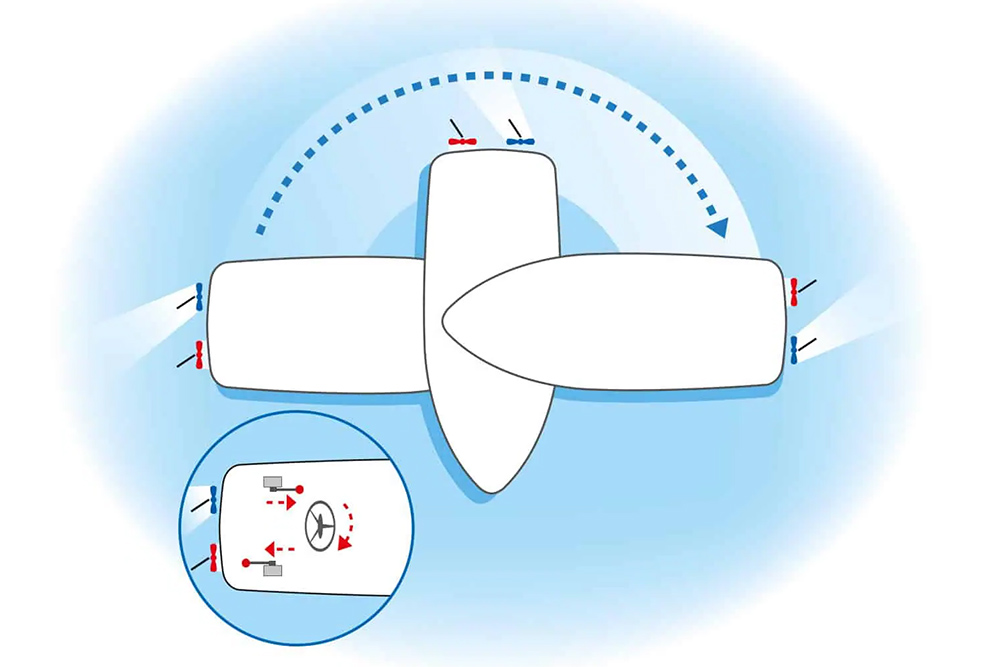
Diagram showing twin-engine boat turning using opposed throttles, with wind direction and manoeuvre sequence indicated
Fig. 2: Turning twin outdrives

In effect, this is just the same as helming a single-engine set-up, but you are getting tighter manoeuvres due to the thrust from the prop being offset from the centreline of the boat – the leverage effect.

Another entirely acceptable method when turning is to use engines opposed to each other. This works on twin-outdrive set-ups and is also the required method for twin-shaftdrive arrangements. With both outdrive and shaftdrive set-ups the method works with the helm centred, but the tightness of turn can be improved with the wheel hard over in the intended direction of turn. I mentioned above that when teaching on twin-outboard/outdrive arrangements my preferred method is to use one engine in a ‘steer then gear’ way.

Top-down diagram of twin-shaft boat pivoting in place using opposed engines and helm input to tighten turn
Fig. 3: Turning twin shafts

The rationale for this is simply that I find a lot of people tend to mix and match ‘steer then gear’ and using the engines opposed rather than focusing on one method. Mixing methods is fine when you are pretty competent and relaxed about handling; however, if you are still developing your capability, mix-and-match methods often lead to confusion when under pressure and things go wrong quickly.

Advertisement

Trailer Boating from MDL advertisement

Using the APE method for safe berth approaches

Having these skills is great, but what about putting them into practice in a marina?

Before we look at a few specific situations, let’s start with how as a skipper we should be preparing to approach a berth. We all like a word that helps to prompt us to remember things – the one I use ahead of approaching a berth is ‘APE’.

‘A’ stands for ‘assess’, by which I mean look around and work out how the boat is likely to be affected near the berth. What way is the tide/stream pushing you? How about the wind? Do you have sufficient depth all around? What other boats are manoeuvring? I would argue that for many people it’s a lack of assessment and thinking through those influences that leads to a plan for the approach that is worse than it could be.

‘P’ predictably stands for ‘plan’. Factoring in wind, tide, depth, etc., what’s the plan for the approach?

‘E’ is for ‘execute’ the plan, but there’s an extra ‘E’ – ‘escape’. Have a plan to escape if it goes pear-shaped.

Marina layout diagram showing berth approaches A to E with wind direction and boat manoeuvring paths marked
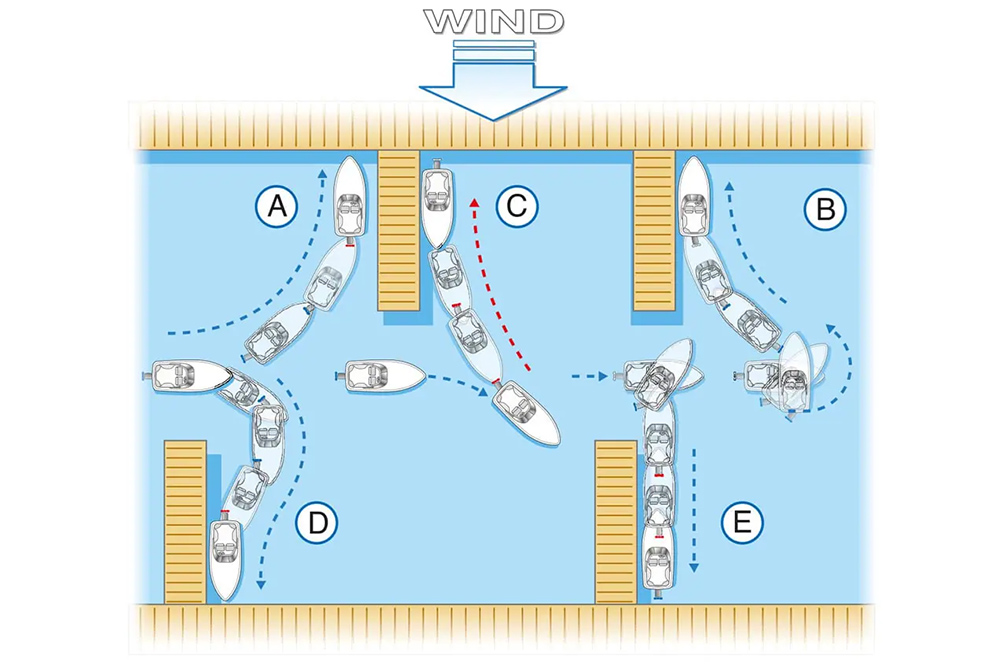
Fig. 4: Marina handling

Let’s look at these berths:

Berth A: Wind on the bow approach strategy

Berth A – Assess: Wind will be on the bow, so we will need to make sure that we control the bow as the wind will be fighting us constantly on approach to rotate the boat to side on. The turn to port on approach will lead to some sideways momentum onto the berth. It will be necessary to ensure that the momentum doesn’t carry the craft into the end of the finger. Plan: Approach the berth staying slightly upwind. Slow down and rotate the craft to allow a 30-degree angle of approach. Go into/out of gear into the berth managing the bow.

Execute/Escape: If need be, stop short of the berth and let the bow go. Make sure there is space for the bow to rotate. Reverse clear and go again.

Berth B: Controlling momentum off the berth

Berth B – Assess: Into the wind again, but this time the danger is that turning and driving into the berth as a single movement will create momentum off the berth. Plan: Slow down on approach. When adjacent to the finger, put a turn in so as to create an angle of approach of about 30 degrees. Then there are the same issues as for Berth A with momentum now onto the berth. Execute/Escape: Same as for Berth A.

Advertisement

Nordkapp_MPU_Dec25

Berth C: Reversing into the berth with control

Berth C – Assess: This time a reverse into the berth. Craft will hold very steady when stern to wind. Wind from the same direction as for A and B. Plan: Go slightly past the berth. Arrest forward movement. Get a 30-degree angle of approach. Reverse into the berth with momentum onto it.

Execute/Escape: Go to neutral and let the wind push you away from the berth.

Berths D and E: Applying the APE marina methodology

Berths D & E: Over to you! Use the APE methodology to come up with a plan and we’ll share our ideas for these berths in the next article.

Marina handling top tip for twin-engine boats

If using the engines opposed to each other, don’t place a hand on each throttle – just use one hand and move it between the throttles as needed. In my experience, very few people’s brains can cope with one hand on each throttle when placed under pressure. Alternating the hand uses less brain space and slows down the movements.

Next time we’ll look at what we do when we get to the berth. How should we be working the lines? How do we keep our crew safe? What tips and tricks do we have to make those final few metres easier?

Keep safe and have a great time afloat!

Powerboat and RIB

Paul Glatzel

Tuition Writer | RYA Instructor | Author of RYA Powerboat Handbooks | Powerboat & RIB

Advertisement

Nordkapp_MPU_Dec25
Trailer Boating from MDL advertisement
  • Pantaenius insurance advertising banner with No Nonsense, Get a Quote, No policy cancellation fees, No policy admin fees, no monthly instalment fees.
  • Boatfests 2026 advert

You might also like