

AutoCaptain: how Simrad is redefining the art of docking

Brandon Ferriman, Director of Autonomous Docking at Navico, and Jason Arbuckle of Brunswick explain Simrad's AutoCaptain, an autonomous docking system built to complement Mercury's Joystick Piloting technology, using stereo camera vision and machine learning to reduce stress and simplify docking.
27 May

Edited May 27, 2026

Powerboat and RIB

Content by Powerboat & RIB

Sponsored

This article is editorially produced by Powerboat & RIB in partnership with Simrad Yachting

Powerboat and RIB
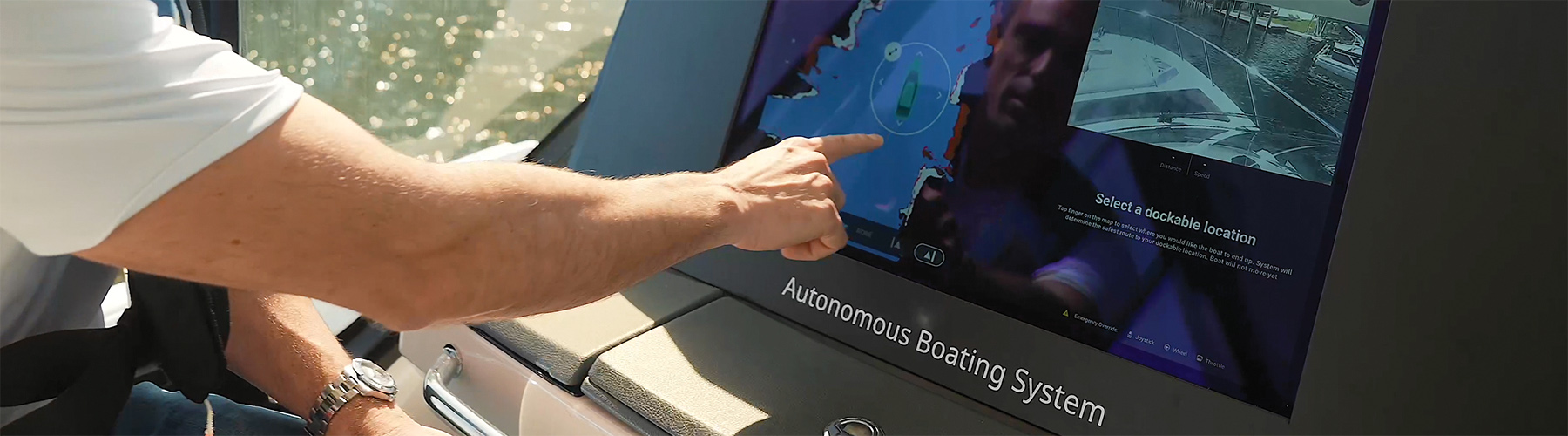
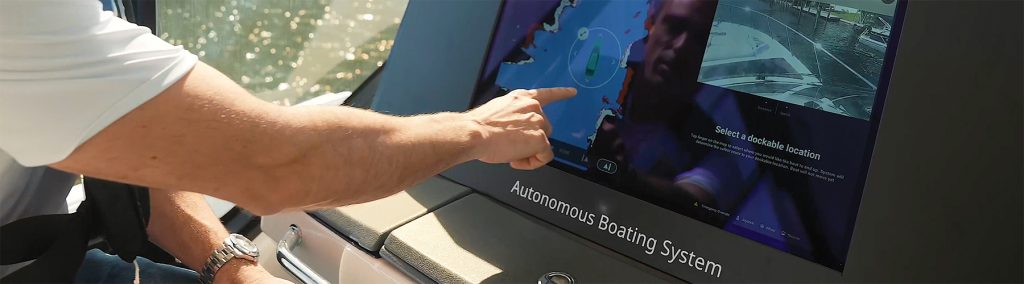
Man at helm using Simrad AutoCaptain autonomous docking system

Share this Article

Understanding what it does and how it works

There is a moment familiar to almost every boat owner: the engine idling down, a tight berth ahead, wind nudging the hull sideways, and the quiet, creeping tension of bringing a large vessel safely home. For decades, that moment has separated the confident from the anxious, the experienced from the novice. Now, Simrad’s AutoCaptain is changing what that moment feels like entirely.

AutoCaptain is not simply another piece of marine electronics. It is a fully integrated, camera-driven autonomous docking system that builds upon the foundations already laid by Mercury’s Joystick Piloting technology, and then goes considerably further. Understanding what it does, how it works, and why it was built requires a closer look at the problem it was designed to solve.

We asked Brandon Ferriman, Director of Autonomous Docking for Navico and Jason Arbuckle of Brunswick, the two companies behind the technology, to explain how AutoCaptain works, what drove its development, and why they believe intelligent helm systems represent the next meaningful step forward for recreational boating.
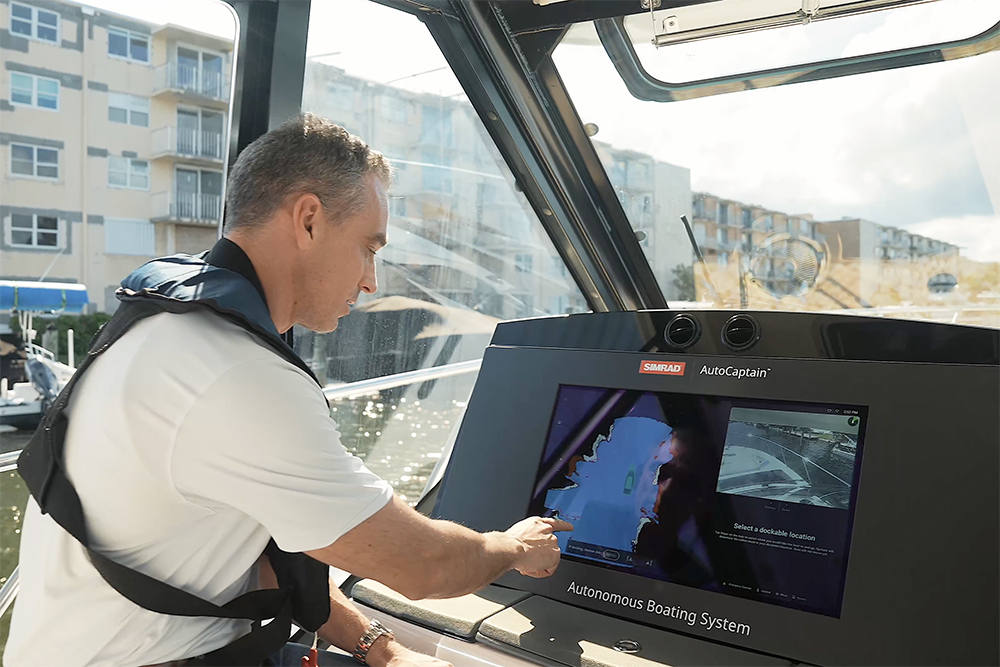
Man at helm using the touch screen of a Simrad multi function screen to operate autonomous docking system
Brandan Ferriman uses AutoCaptain to dock into a difficult marina berth.

Why docking needed a smarter solution

Mercury’s Joystick Piloting technology has already made close-quarters manoeuvring significantly more accessible, giving captains precise directional control across all three axes of movement for vessels running between one and four outboard engines. By any measure, that was a meaningful step forward. But Simrad recognised that even with joystick control, the fundamental stress of docking a larger vessel remained largely unchanged.

The challenge is not purely mechanical. It is perceptual. A captain on the helm cannot easily see every corner of their boat at once. At the same time, they are managing engine response, monitoring wind and current, watching for other vessels, and communicating with anyone on the dock. AutoCaptain was created to address that problem directly, not by replacing the captain, but by providing an additional layer of awareness and control that reduces the cognitive load of docking to something far more manageable.

The goal, as both men describe it, is straightforward: to lower the barriers to entry for new boaters, while delivering a measurable benefit to those who have been on the water for years.

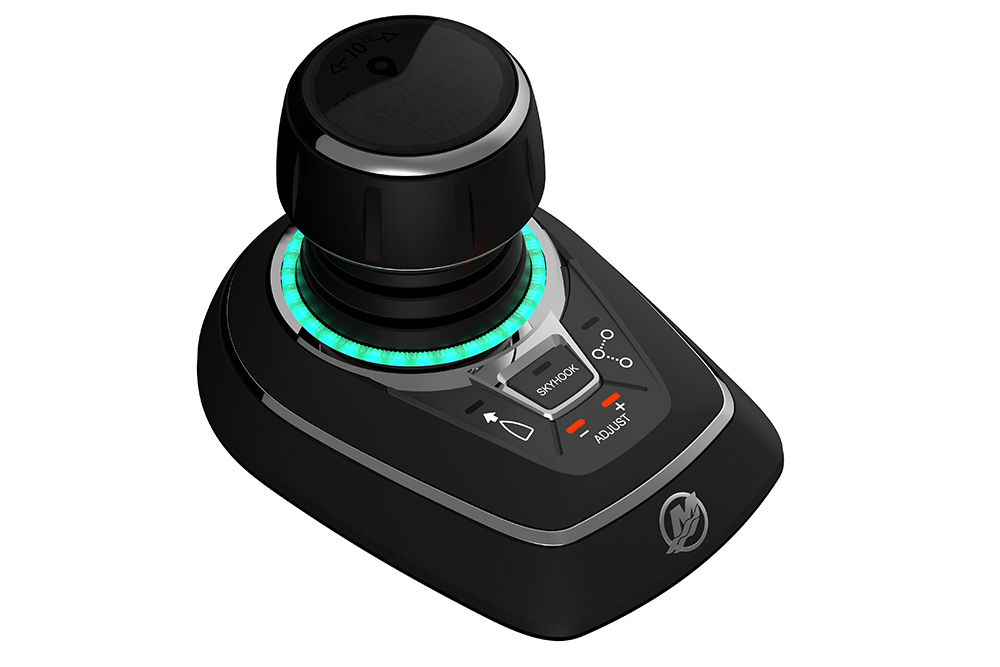
Product image of Mercury joystick.
Mercury's joystick control.

The eyes of the system: how AutoCaptain actually sees

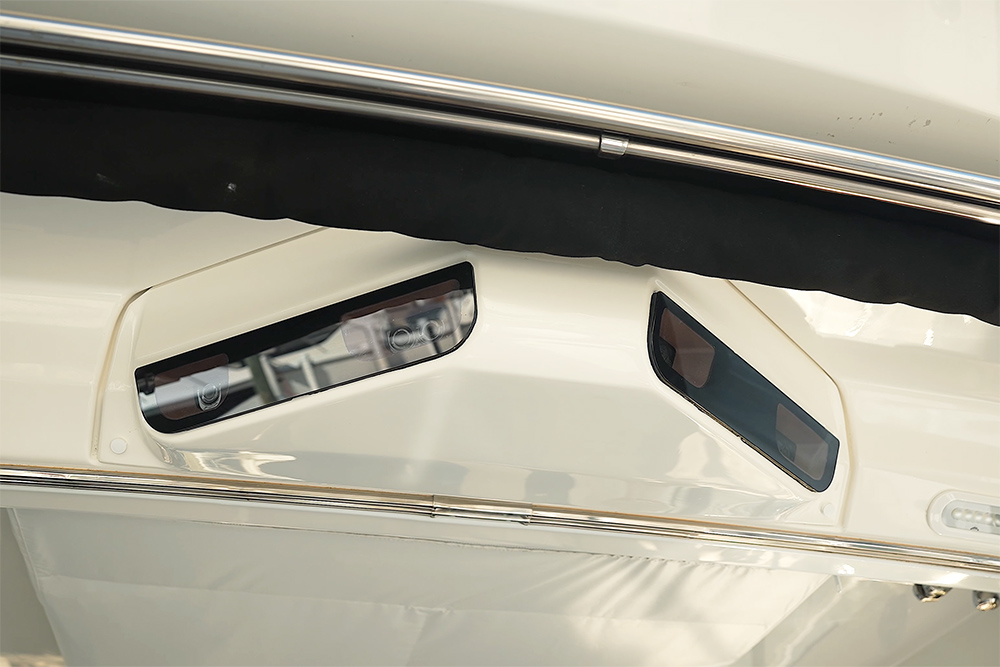
At the heart of AutoCaptain is a network of stereo cameras, and the distinction between stereo vision and conventional single-lens camera systems is worth understanding. Each stereo camera houses two lenses which work in tandem to identify objects around the vessel and calculate their precise distance, functioning in a way that closely mirrors the mechanics of human binocular vision. The critical difference is that these cameras carry a larger aperture than the human eye, allowing them to draw in considerably more light.

The practical consequence of that design choice is significant: AutoCaptain is capable of operating reliably in low-light conditions that would challenge human perception. Whether approaching a berth at dusk or navigating a poorly lit marina after dark, the system maintains its spatial awareness.

Importantly, the development team investigated alternative sensing technologies during testing, most notably Lidar. What they found was that Lidar proved susceptible to reflections off water surfaces, introducing a potential source of unreliable data in the very environment where the system needs to perform most consistently. Camera-based stereo vision did not share that weakness, which is why it forms the backbone of AutoCaptain’s perceptual architecture.

The system provides multiple camera views around the vessel, giving the captain access to perspectives that would be impossible to obtain from the helm alone. This is a meaningful advantage when manoeuvring into tight spaces or navigating crowded marinas.

Advertisement

  • Nordkapp Enduro 605 MPU advertisement
  • Nordkapp Enduro 830 advertisement banner

Interested in autonomous boating?

Find out more about Simrad AutoCaptain, the advanced autonomous boating system built to help reduce stress during the toughest moments on the water.

Powerboat and RIB
Two sets of installed AutoCaptain cameras to a boat
AutoCaptain uses a network of stereo cameras installed at the time of manufacture.

Real-time awareness: the intelligence behind the cameras

Capturing a picture of the world around the boat is only the beginning. What AutoCaptain does with that picture is where the deeper technology resides.

The system employs computer vision machine learning (CVML), a model that has been trained to detect and classify objects specific to the marine environment, and which runs entirely on the vessel in real time. Developing that model required solving a problem that is easy to underestimate: the recreational marine world is extraordinarily diverse. Water surfaces vary in colour, clarity, and behaviour. The vessels sharing any given stretch of water come in every conceivable shape and size. The objects a boat might encounter, from buoys and jetties to other craft and dock structures, are not the kinds of things a model trained on land-based imagery would reliably recognise.

To build a genuinely effective CVML model, the team turned to Freedom Boat Club (FBC). Using a portable data acquisition system, data logs were collected across a wide range of FBC locations throughout the United States, capturing the true breadth of conditions a recreational vessel is likely to encounter. That data was then curated, labelled, and used to train the model that now runs inside AutoCaptain.

While the model does not continue learning independently once it has been installed on a vessel, it is designed to be updated and improved over time through software releases. As the platform matures, the model’s capabilities will grow with it.

360-degree awareness, continuously

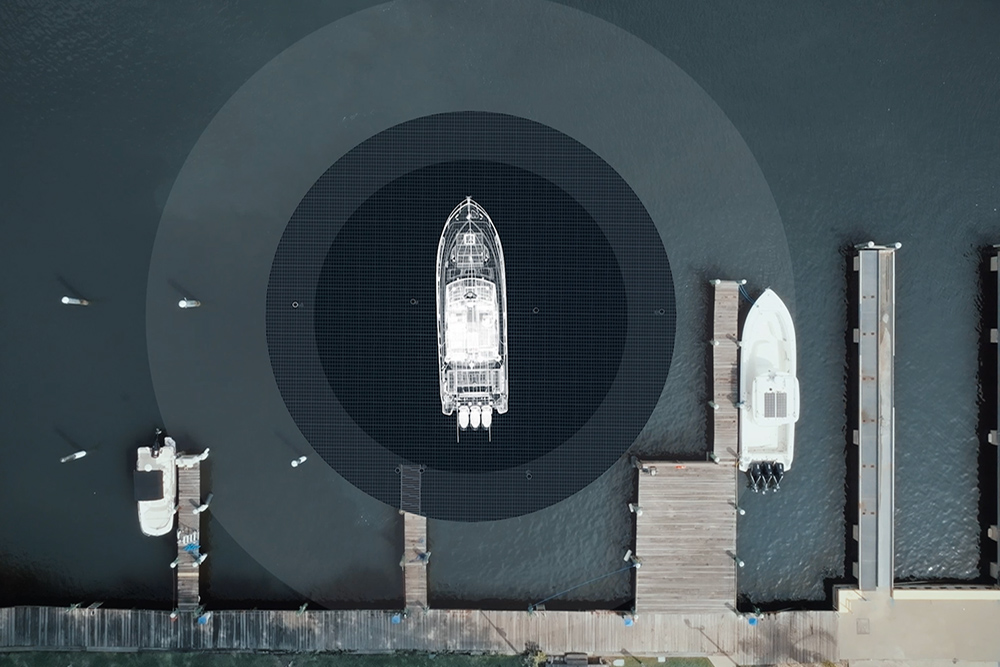
One of AutoCaptain’s most practically valuable characteristics is that its environmental monitoring does not stop once a docking sequence begins. The system maintains continuous 360-degree awareness of objects around the boat throughout the manoeuvre, reacting in real time to any changes that might affect the intended path.

This matters because marinas are not static environments. Another vessel may swing on its mooring, a tender may drift across a fairway, or a dock line may shift unexpectedly. AutoCaptain accounts for these dynamics as they happen, rather than relying on a fixed picture of the world taken at the start of the approach. For a captain managing everything else that demands attention during docking, that persistent situational awareness is not a luxury. It is the difference between a controlled approach and an expensive surprise.

Illustration of 360 degree view of a docking vessel

Navico Group

The system maintains continuous 360-degree awareness of objects around the boat throughout the manoeuvre.

Advertisement

Trailer Boating from MDL advertisement

Who benefits from AutoCaptain?

The honest answer is: almost everyone who docks a larger boat.

There is a common concern that systems of this kind make boating too easy, that they erode the skill and judgement that experienced captains have spent years developing. The thinking behind AutoCaptain takes a different view. The aim has never been to remove the captain from the equation. It has been to assist them, particularly during the phases of boat handling that are most demanding.

For new boaters, close-quarters manoeuvring and docking represent some of the highest barriers to confidence and enjoyment. A system that reduces the stress of those moments does not diminish the experience of being on the water. It extends that experience to people who might otherwise find it too daunting to pursue.

For seasoned captains, the calculus is different but the value is equally real. Experienced mariners who boat alone, or with guests who are unable to assist during a docking sequence, will find that AutoCaptain fills the gap that a second experienced crew member would otherwise need to occupy. The system handles the demand for constant all-round awareness so that the captain can focus their attention where it is most needed.

For new boaters, close-quarters manoeuvring and docking represent some of the highest barriers to confidence and enjoyment.

Brandon Ferriman demonstrates the features and abilities of Simrad AutoCaptain.

Installation: an OEM-first approach

AutoCaptain is not an aftermarket add-on. It is installed by the original boat builder, in close collaboration with Navico, the parent company of Simrad.

That approach is deliberate. Precise placement of the camera sensors is fundamental to the system’s effectiveness, ensuring there are no blind spots and that each camera’s field of view is correctly aligned and maintained. Factory installation allows the boat builder to integrate the system’s components in a way that is consistent with the vessel’s overall design language, preserving the aesthetics of the boat rather than compromising them with external hardware. Navico works directly with each boat builder to create a kit tailored to their specific requirements, ensuring the installation meets the system’s exact specifications.

Calibration, servicing, and warranty

Calibration takes place shortly after the vessel leaves the factory. The process uses calibration targets to calculate the precise position of each camera relative to the others and to the vessel itself. Once completed, the system does not require ongoing recalibration. The only exception is if a camera is replaced during service.

For servicing, AutoCaptain is designed to work with standard marine diagnostic tools, including the Mercury G3 tool, allowing dealers to diagnose and replace components using familiar equipment. The system is backed by a two-year limited warranty that provides global coverage.

Advertisement

Advertisement for Navan boats, saying Engineered to perform
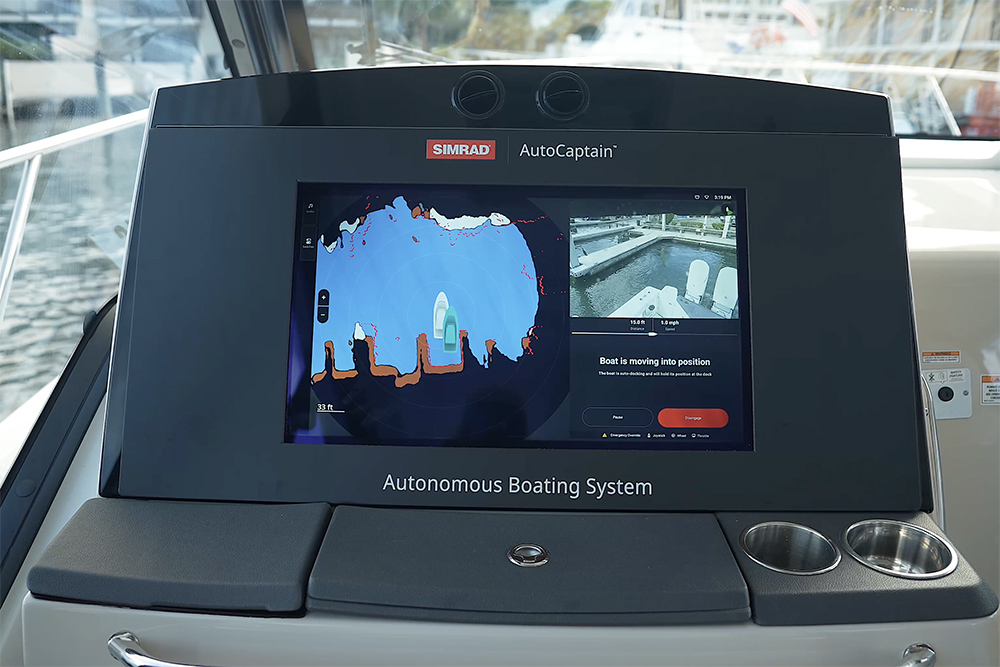
Dashboard view with Simrad AutoCaptain installed
Simrad AutoCaptain control centre MFD.

A platform built to grow

AutoCaptain is designed from the outset as a platform rather than a fixed product. Its current capabilities, centred on close-quarters manoeuvring and docking, represent the first chapter in a longer story. Software updates will expand the system’s feature set over time, and the development team are actively exploring on-plane features as well as opportunities to bring the underlying technology into additional market segments.

The ambition is clear: to make intelligent vessel management available to a broader range of boats and boaters, progressively, as the technology and the platform continue to develop.

The bigger picture

What AutoCaptain represents is a considered answer to a question that the marine industry has been circling for some time: how do you take genuinely complex technology and make it serve people rather than intimidate them?

The answer, in this case, involves stereo camera vision trained on real-world marine data, a processing architecture that runs entirely on the vessel, continuous environmental monitoring, and a design philosophy that keeps the captain central to everything while removing the most stressful elements of close-quarters boat handling.

For anyone who has held their breath during a difficult docking, and for the growing number of boaters who would like to reach the water without that feeling in the first place, AutoCaptain is a significant development. Not because it replaces skill or judgement, but because it makes both considerably easier to deploy.

Interested in autonomous boating?

Find out more about Simrad AutoCaptain, the advanced autonomous boating system built to help reduce stress during the toughest moments on the water.

Powerboat and RIB

Advertisement

  • Nordkapp Enduro 605 MPU advertisement
  • Nordkapp Enduro 830 advertisement banner

Join 8,000+ boaters who get our weekly Reader’s Bulletin

Get the latest from Powerboat & RIB Digital Boating Platform delivered to your inbox

• Reviews and features
• Breaking marine news
• Latest videos
• Events & show coverage
• Exclusive offers

Free. No spam. Unsubscribe anytime.

Powerboat and RIB

Powerboat & RIB

This article was created by the Powerboat & RIB editorial team.

Advertisement

  • Nordkapp Enduro 605 MPU advertisement
  • Nordkapp Enduro 830 advertisement banner
Advertisement for Navan boats, saying Engineered to perform
Trailer Boating from MDL advertisement

You might also like