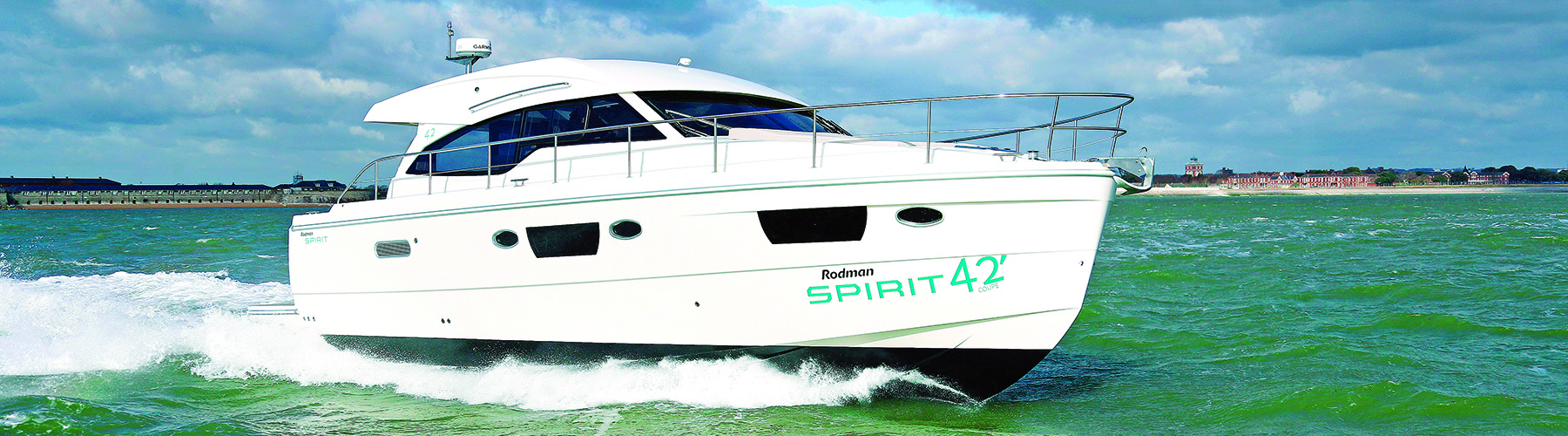

Rodman Spirit 42 Coupé review: a stylish cruiser with true Rodman toughness

We test the Rodman Spirit 42 Coupé, a stylish sports cruiser that marks a bold new direction for the tough Spanish yard, to see how she handles a choppy Solent.
04 Jun

Edited June 4, 2018

Powerboat and RIB

Content by Greg Copp

Powerboat and RIB

Share this Article

Stepping aboard: deck, build quality and cockpit

Rodman’s new Spirit 42 Coupé marks a threshold for this established Spanish yard. Having built a range of big flybridge craft, practical pleasure boats, tough fast fishers and even tougher military patrol vessels, the Spirit 42 looks somewhat un-Rodman. I mean no disrespect, however, as within moments of stepping aboard, the Rodman DNA becomes evident.

For starters, the 12in side decks are a giveaway, as are the tall, sturdy guard rails, the abundance of coachroof handrails and the chunky cleats. Walking forward to the big 1kw windlass, the cheese grater-like non-slip decking and 5in-deep toe rails would reassure the most tentative of crewmembers. Even the foredeck sun pad was tough enough not to slip an inch in the feisty conditions of the test day.

Like the bathing platform, the cockpit is an expanse of synthetic teak, with substantial steps on either side leading to the side decks. Real teak is also an option, but given the quality and maintenance-free aspect of Rodman’s counterfeit teak, there’s little point paying extra to reduce the planet’s teak reserves. Engine access is via cockpit hatches in the stern quarters. There is also the option of an additional large central cockpit hatch, as used on the Spirit 42 Flybridge version – a must, since squeezing down the sides of the engines via the stern quarter hatches to access service items is far from ideal, especially when the motors are hot. The raw-water strainers, at least, are easily accessed outboard of each engine. One thing these quarter hatches do give you is great fender storage, which is probably what they were originally designed for.
At a glance

Rodman Spirit 42 Coupe

About this boat

A 12.35m coupé sports cruiser from Spanish builder Rodman, marking a stylish new direction for a yard best known for tough, practical craft.

  • Type:

    Sports Cruiser, Weekender

  • Hull:

    Moderate-deadrise hull

  • Power:

    Twin 300hp Volvo Penta IPS 400 (test boat) or twin 370hp Volvo Penta IPS 500

What is the boat used for?

Coastal cruising, weekending and day trips for couples and families who want easy, joystick-assisted handling.

How much does it cost?

From £366,000 (inc. VAT); £382,746 as tested.

A bright, contemporary saloon

Entering the saloon courtesy of a sturdy full-width patio door takes you into a clinically neat, contemporary world. The design is minimalistic, and everything, right down to the fridge-freezer door and the carpet, is a matching light-grey colour. Different floor and hull colour options are available, and though the joinery is veneer, the quality of the workmanship is high. All the doors open and close with precision and have flush catches, so there’s nothing to catch your legs on during a bumpy passage.

The huge electric sunroof enables the saloon to be bathed constantly in sunlight. The GRP ceiling moulding is impressive in its fit and finish, giving a high-quality feel to the internal superstructure that headlining panels do not. The adjustable leg and platform for the contemporary glass-topped table is a substantial affair. The TV sitting on the cabinet opposite looks vulnerable, until you realise its four legs are screwed down – it took the choppy conditions of the test day in its stride.

This is a typically tough Rodman with an efficient hull, whose crew will give up long before it does.

Greg Copp

Galley, cabins and accommodation

The living accommodation comprises a neat but compact galley, two cabins and two heads. Like many contemporary sports cruisers, the galley design is realistic about what people are likely to cook on this type of boat. The fridge-freezer is fairly generous, but the other facilities consist simply of a 240V double ceramic hob, a 12V microwave, a sink and under-top storage – this galley is built for small meals, snacks and drinks in a social environment, not feeding a crew on long passages. The joinery and worktop are precise and clinical, with a light-oak-effect floor.

The mid cabin sits under the helm on the starboard side, with two 6ft 1in single berths and a mid-height hanging locker. It is well lit from two portholes and has en suite access to the day heads, though standing headroom, as is often the case, is just inside the doorway. The day heads, like the master cabin en suite, is well appointed, with a cylindrical self-contained shower and 6ft 5in of headroom. The master cabin, though far from small, feels it has paid a small price for the second heads compartment. The island double berth, like the mid-cabin beds, could do with a couple of extra inches – at 6ft it was fine for our tester, but anyone taller might find it slightly short. This cabin has plenty of stowage in two full-height deep hanging lockers and under-bed drawers, and enjoys plenty of natural light.

Advertisement

Navan - Engineered to Perform

Helm position, visibility and the dashboard

One area of the boat that deserves a separate mention is the helm. It is simply too high – Rodman are redesigning this aspect with a lower seat and larger windows on each side. At the moment the seat gives a commanding view within the saloon, but the window line is too low for this elevated seating position: sitting normally and looking to port, visibility was limited to about 15ft beyond the boat, and when banked over turning to port, the port beam effectively became a full-length blind spot, best dealt with by having a crewmember watch that side. In contrast, the big patio door hides nothing astern. The seat needs to be shorter by around 6 to 9in, which is realistically possible.

The dash layout on the test boat, which only had a 9in plotter and no VHF, looked bare, though it can easily accommodate a 12in, or possibly larger, display system. The IPS joystick comes as standard, a feature that has done much to encourage tentative boaters to use their boats. Ergonomics are good, with the throttles and wheel falling easily to hand.

Engine options: IPS 400 vs IPS 500 performance

It was a bit surprising to find that this boat had twin 300hp Volvo IPS 400s, given a beamy 11-tonne boat might be expected to carry twin 370hp IPS 500 or even 435hp power. That said, the IPS 400 puts out an impressive 518ft/lb of torque from each engine at just 2500rpm, and proved capable of pushing the Spirit 42 quickly onto the plane at around 16 knots. Within moments she was running at her sweet-spot cruising speed of 22 knots, a comfortable and frugal speed with these engines. Pushing beyond, the boat had no problems reaching a 28.5-knot top speed, on a pretty choppy day. Rodman were forerunners in the IPS revolution, and have had over a decade to come to terms with the fact that a good IPS boat needs a hull designed specifically for this method of propulsion.

Rodman claimed 29.9 knots the previous day when the weather was calmer. Nevertheless, the IPS 500 would be a better option, and costs £10,800 over the IPS 400. The big 5.5L D6 engine block this engine uses produces a whopping 650ft/lb of torque at 2000rpm, which would make better sense for this boat. These motors would sit comfortably at a 26/27-knot cruising speed, with a top speed of around 33 knots – and, more significantly, better ability to deal with increased loading, rough weather and extra hull growth at the end of the season. At like-for-like cruising speeds, the IPS 500 would also prove more frugal.

Handling and ride quality in rough water

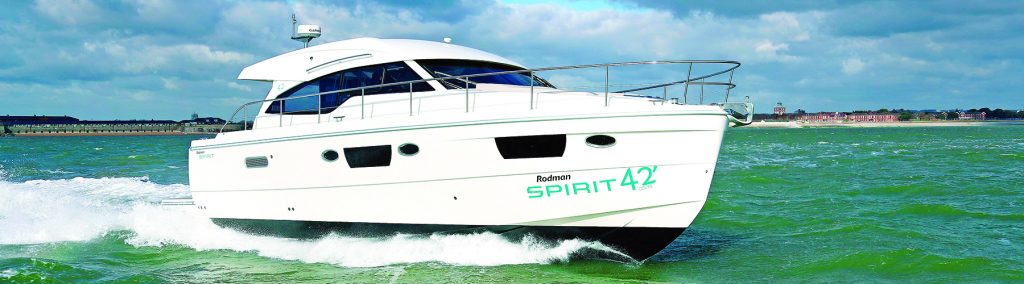
Running into the typically choppy Solent the day after several days of persistent winter wind, you could feel the wide beam of the Spirit when hitting head seas of over 25 knots. She is no rakish deep-vee boat, but her fore section is capable of dealing with a fair degree of punishment, helped by the fact that Rodman construct their boats to be abused. Her natural fore and aft trim is very good – some IPS boats can have a bow-up attitude, but the Spirit 42 does not have this problem. Trim tabs are an option that this boat did not have fitted, because it doesn’t really need them.

Even with a 15- to 20-knot wind on the beam, there was no noticeable leaning into the wind. Banked over, you feel the boat’s 14ft beam, and apart from the chine sections slapping against the sharp chop, the boat feels very stable. Her angle of list during full-power, full-lock turns is reassuringly sensible – there’s no chance of losing the plot if you overcook it. There is a degree of steering resistance as you turn the wheel to the limit, produced by the chines digging in. She is no sluggard in the turns, though some comparable stern-driven boats steer more quickly – but then that’s not what the Spirit 42 is about.

Fuel consumption and running costs

Fuel consumption figures below are for both engines, recorded via the Volvo fuel flow meter.

Engine speedGPHKnotsMPGSound level (dB at helm)
1000rpm1.57.04.769
1500rpm3.78.42.371
2000rpm7.710.31.373
2500rpm12.615.41.277
3000rpm17.221.81.379
3500rpm22.227.61.282
3630rpm (WOT)25.328.51.187

Specification

LOA 12.35m (40ft 8in)
Beam 4.24m (14ft)
Transom deadrise angle 14 degrees
Displacement 11,000kg (dry)
Power options Twin 300hp Volvo IPS 400 or twin 370hp Volvo IPS 500
Fuel capacity 1,150 litres (153 gallons)
RCD category B for 12
Test engines Twin 300hp Volvo IPS 400
Top speed on test 28.5 knots (2-way average), sea conditions F4 gusting F5
Price from £366,000 (inc. VAT)
Price as tested £382,746 (inc. VAT)

Advertisement

  • Navan - Engineered to Perform
  • Website banner advertisement for MarineTrac with Protect, Track and Recovery

Find out more

Visit RBS Marine, the UK dealer for Rodman boats.

padlock icon

Subscribe now for only £2.99 a month. Cancel anytime.

Access premium editorial and exclusive content and our complete digital archive. Subscribers also enjoy additional benefits, including exclusive offers and access to our expert advice line.

Powerboat & RIB subscription

Advertisement

  • Grand boats M:PU advertising banner G680 Best in Class
  • Sterk Boats advertising banner for Strerk 31 T-Top powerboat
  • Airborne 7 RIB advertisement - invitation to explore he airborne 7
Powerboat and RIB

Greg Copp

Technical Editor | Powerboat & RIB

You might also like