

Williams TurboJet 280MX and 320MX review: premium jet tenders at an entry-level pricing

Williams Jet Tenders built its name on small, high-performance high-quality jet tenders. We test the brand's two newest entry-level models, the Turbojet 280MX and 320MX, to see whether they live up to that reputation without the usual price tag.
17 Sep

Edited September 17, 2026

Powerboat and RIB

Content by Hugo Montgomery-Swan

Independent Review

This review is editorially independent: our journalist's testing, opinions and conclusions are entirely their own. Only its promotion is supported by Williams Jet Tenders

Powerboat and RIB
Powerboat and RIB

Share this Article

Introduction to Williams Jet Tenders

In the competitive world of high-end yacht tenders, there is one company that has chosen the course of committed specialisation now for 22 years. With such a history, it’s hardly surprising that the team at Williams Jet Tenders understand what the market wants and know how to respond with the right product at the right time. The launch of their two new MX TurboJet models, the 280MX and 320MX, underscore this fact and in the current market where price point is critical, we think you’ll be surprised to learn just how keenly prized these two new ‘pocket rockets’ truly are…
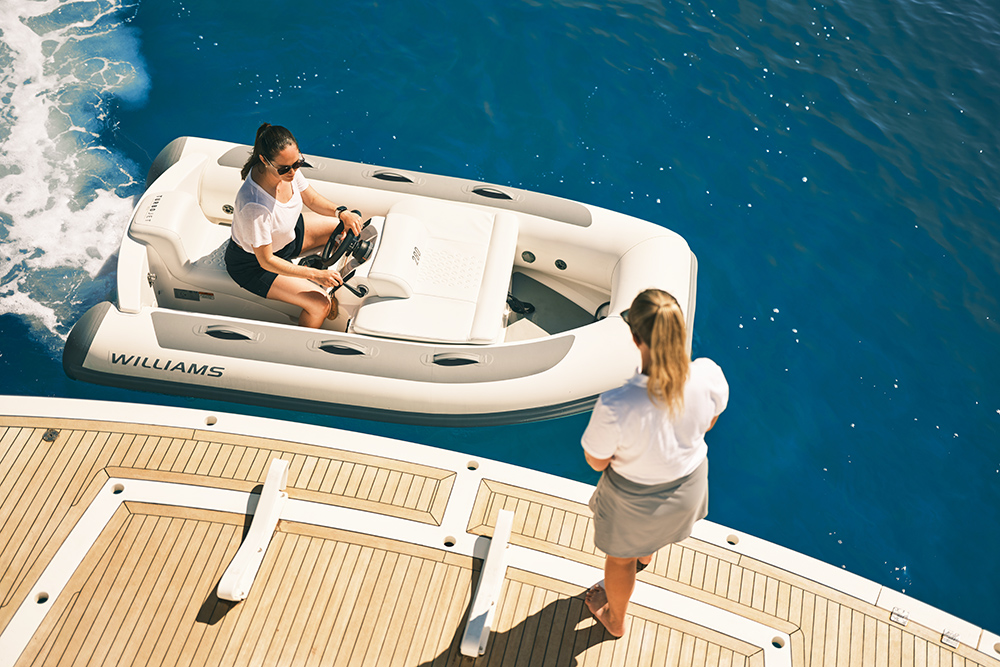

Williams MX jet tender appraoching stern of motoryacht
Motoryacht and superyacht shipyards favour working with an experienced company such as Williams Jet Tenders.

Why superyacht shipyards favour Williams Jet Tenders

In the world of small, fast tenders, there are few names as respected and well established as Williams Jet Tenders. No doubt for the reason that ever since its inception in 2004, the company has resolved to unwaveringly specialise in this niche sector of the boat building industry. As a result, Williams have become experts and leaders, not only in the building of small, high-performance, jet powered tenders, but also in the all-important area of legislation and certification.

In the complex and bureaucratic parameters within which the ship building industry functions, the technicalities of design, compliance and certification are onerous, costly, and time consuming. Not surprisingly, therefore, shipyards favour working with suppliers and project partners whom they can trust – those that have built up a track record of excellence. Those, like Williams Jet Tenders for instance, that have the necessary real-world experience to enable them to faithfully deliver at every stage of the build process, right through to project completion and the client’s eventual sign-off.

At a glance

Williams TurboJet 280MX

From

£17299

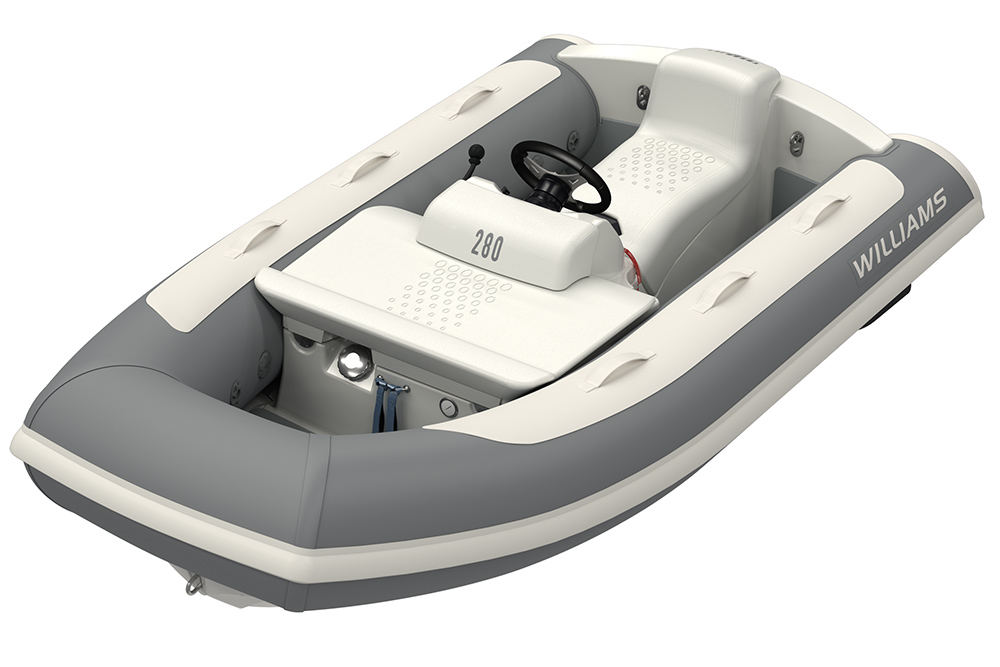
A compact, entry-level jet tender built for safe ship-to-shore transfers and sociable family watersports.

About this boat

  • Type:

    Jet Tender

  • Power:

    BRP Rotax Ace 903, 60hp petrol

What is the boat used for?

Its main purpose is ship-to-shore transfers and general watersports fun, including towing a mono-ski. Its light, efficient hull and simple, point-and-shoot handling make it a practical, easy-to-use tender for a 40-70ft mothership.

How much does it cost?

RRP: £17,299 (280 model, BRP Rotax Ace 903 60hp).

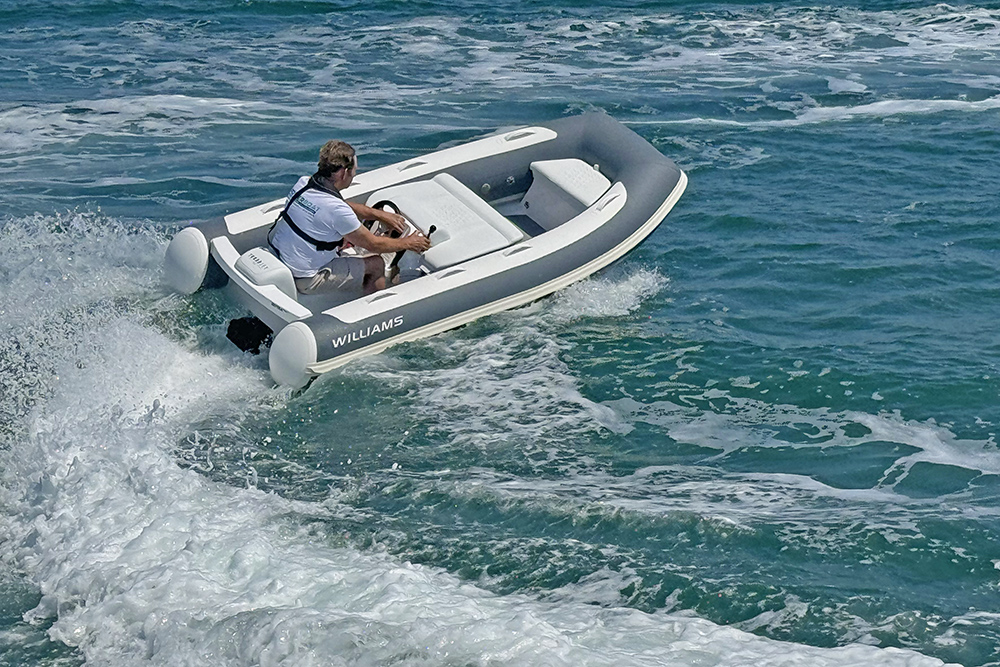
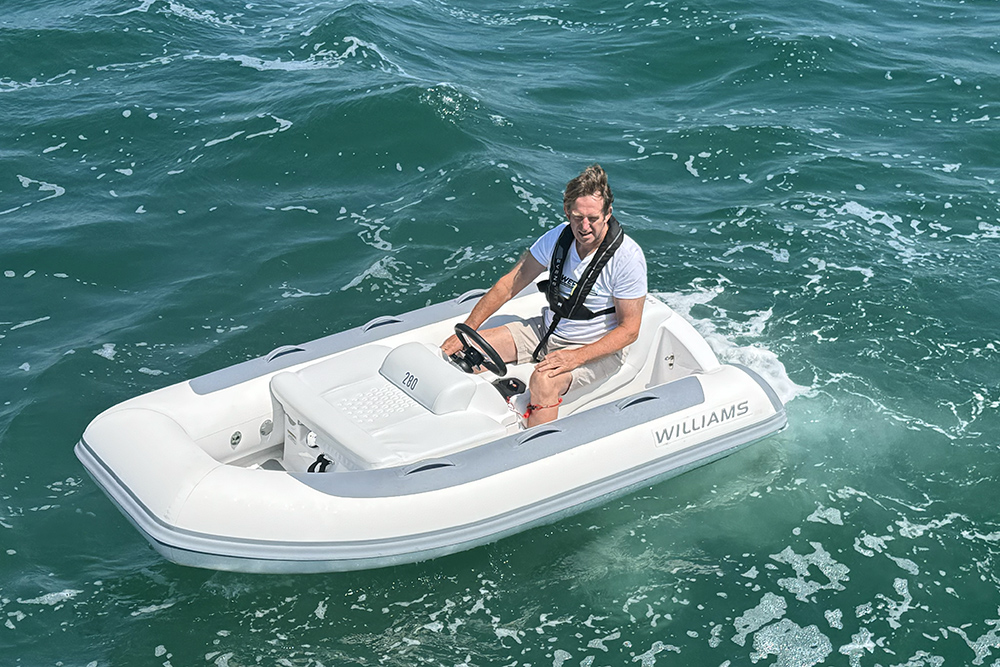
HMS trialing the manoeuvrability of the MX280 during the test this summer.

Learn more about the TurboJet MX280

Want to find out more? Check out the product information from Williams on the TurboJet MX280

Powerboat and RIB

At a glance

Williams TurboJet 320MX

From

£19995

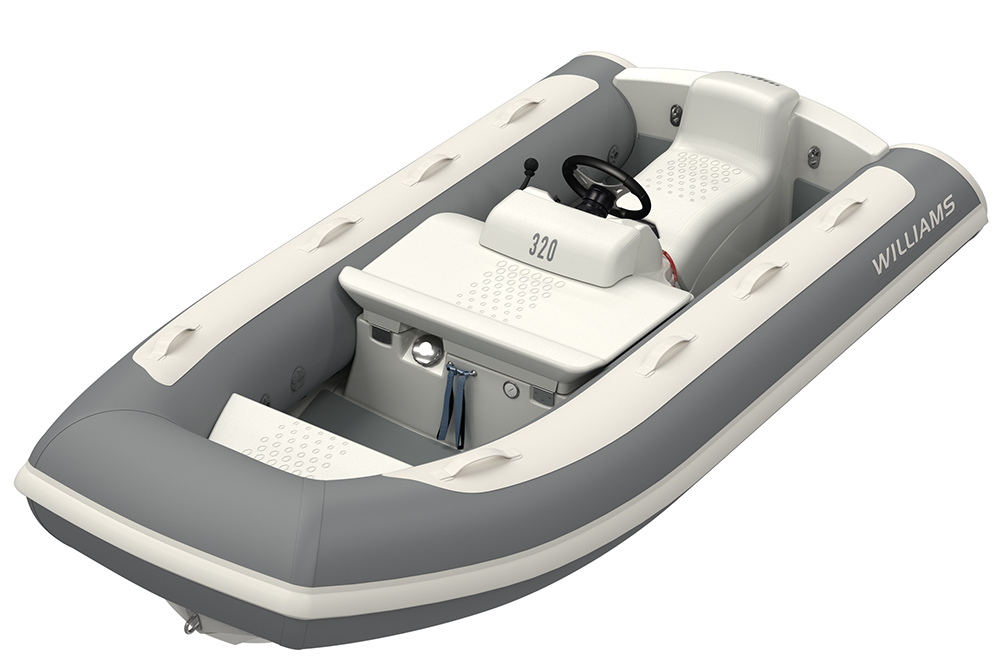
The larger of Williams’ two new MX tenders, built for the same job with extra power and payload in reserve.

About this boat

  • Type:

    Jet Tender

  • Power:

    BRP Rotax Ace 903, 90hp petrol

What is the boat used for?

As with the 280, its main purpose is ship-to-shore transfers and watersports fun, with extra payload capacity for four adults and a child when using the tubes. Williams pitches it at the same 40-70ft yacht market as the 280MX.

How much does it cost?

RRP: £19,995 (320 model, upgraded engine).

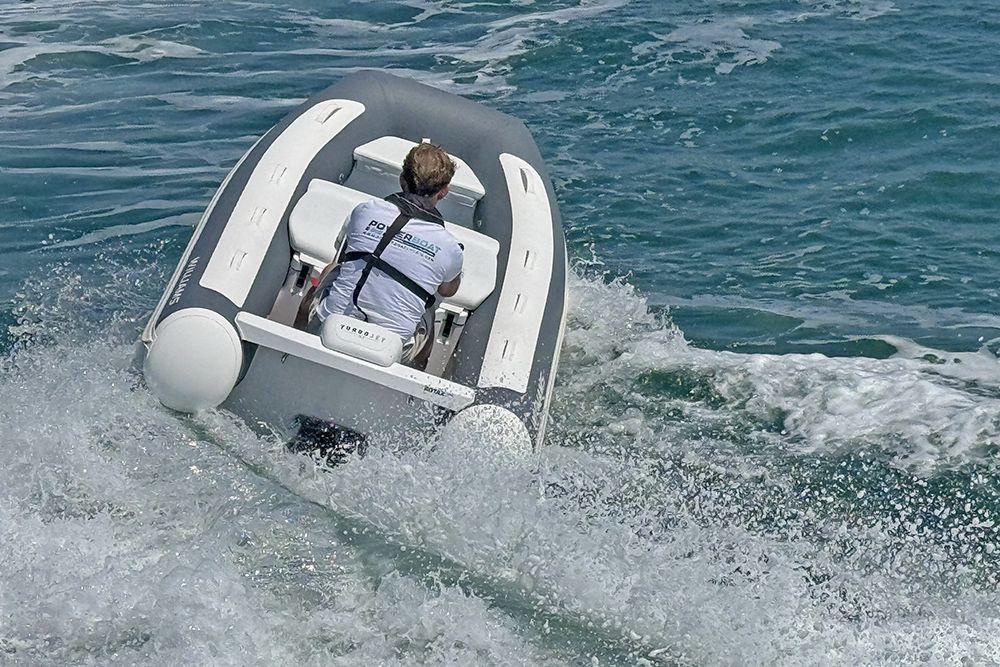
Sea trials on test day of the MX320.

Learn more about the TurboJet MX320

Want to find out more? Check out the product information from Williams on the TurboJet MX320

Powerboat and RIB
CGI image of the Williams TurboJet 320MX
Williams TurboJet 320MX
Williams TurboJet 280MX cgi image
Williams TurboJet 280MX

Why two brand new models? The TurboJet 280MX and 320MX

This August, Williams added two brand new editions to their model lineup, the TurboJet 280MX and its direct relation, the TurboJet 320MX. As per the reputation which precedes the brand, both these vessels are built to very exacting standards and continue to uphold Williams’ reputation for quality in a very laudable and well-executed manner. You could say, “we expect nothing less”. But in this day and age of ramping prices in the supply chain, minimum wage increases, tax hikes, coupled to challenging market conditions that have seen a noticeable slump in 40ft-70ft yacht sales, to produce something as complex as a boat, small or large, to a competitive price whilst still maintain quality, is no easy task.

Powerboat and RIB
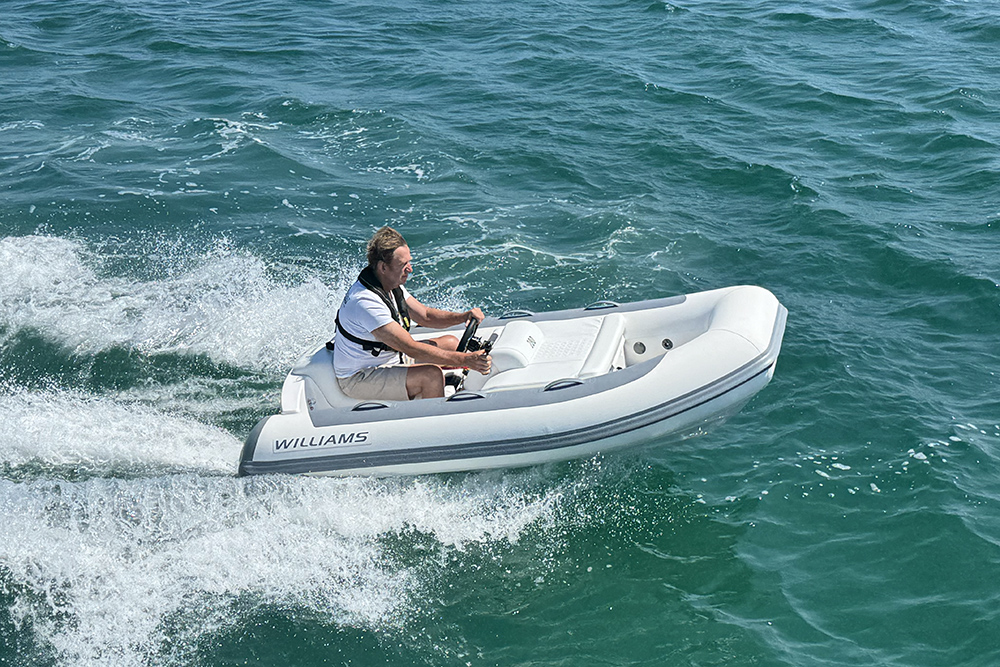
HMS assesses the handling of the TurboJet 320MX tender.

How come the TurboJet 280MX and 320MX are so keenly priced?

The fact that Williams have invested in their very own factory facility, though a considerable and costly acquisition, nonetheless, means the efficiency and controlling of costs and every element of the production line can be managed much more effectively. Even those few elements that are subcontracted, such as all the stainless-steel fabrication, are undertaken using trusted, long-standing suppliers. One advantage this gives the company is the ability to drive down cost. In the case of the new MXs, this translates to £17,299 RRP for the 280MX model and £19,995 RRP for the larger, 320MX. Surprised? I was, because these prices are very competitive for this quality of craft, and not only for a William’s product which usually carries a considerably higher price tag, but also even in relation to the wider recreational boating market. Although these boats are small in size, they are true performers capable of packing a mighty punch.

Dig deeper | HMS chats to Oliver Brown, Head of Product Development for Williams. Join us for the inside story on the development of the new TurboJet MX and Evene tenders range.

Why the MX tenders handle so well

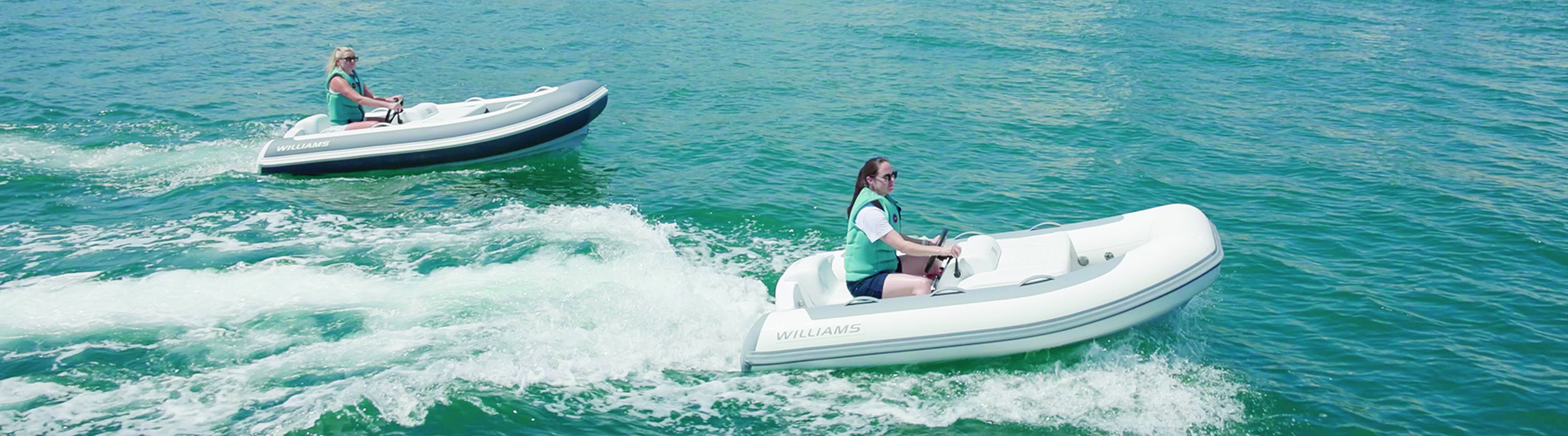
Featuring multiple, downward turned chines that give their shared hull design great lift and forward buoyancy, not to mention reduced hydrodynamic drag, their handling characteristics are outstanding. Put them into a hard lock turn at speed and their ability to hold the water will leave you pretty astounded. These little craft are built to not only provide owners and crew with a lot of sporting fun on the water, including the pulling of a mono-ski, but one of their other prime purposes is to transport valued guests ship-to-shore safe and dry. So, when putting these models through their paces, the latter especially was something I was particularly looking out for. But dry they were and soft riding too!

“…their handling characteristics are outstanding. Put them into a hard lock turn at speed and their ability to hold the water will leave you pretty astounded …”

Learn more about the TurboJet MX280

Want to find out more? Check out the product information from Williams on the TurboJet MX280

Powerboat and RIB

What’s it like to drive a jet-powered tender?

If you haven’t driven a waterjet before, it takes a little while to adjust to their peculiarities. In order to close quarter manoeuvre, remember, it’s the thrust of the jet that provides the steerage. By their nature, jets are more liable to drift at low speeds than their propellor counterparts and although these MX craft feature a traditional wheel setup, which I like, in some instances such as jet skis and even some larger offshore jet-powered RIBs, controlling this tendency may have be countered with a set of handlebars. So again, a different technique is required. Also, a jet doesn’t hold the hull to the water in the same way a prop bites the water. Rather, a jet simply pushes, so in testing conditions a jet powered craft can be subject to a surging, start-stop type motion. In addition, at high speed, a small, lightweight craft such as the MX can be buffered by an oncoming wave more easily if it isn’t met head on. Therefore, understanding jets and how they function and perform is important in order to get the best out of them.

Powerboat and RIB
Driving a jet is very different to an outboard powered RIB.

How stable are the new MX TurboJet tenders on the water?

But the attractiveness of these little MX tenders, is their simplicity. They are so easy to operate that it’s pretty much a case of ‘point and shoot’. Their standing start response is instant. Their acceleration at any point in the rpm range, breathtaking, particularly in the case of the MX 320. And whether at rest or underway, these boats, being true RIBs, are as stable as oilrig platforms! You can also stop within a boat’s length. Plus, of course, being jet powered, there is absolutely no risk of prop injury to swimmers and other water users. But beware if you intend using these or any other jet powered craft in waters where there is floating debris or seaweed. A jet intake can get clogged and cleaning it out can be a pain.

“This means even greater security in the saddle when riding these little ‘ponies’ with the ‘bit between your teeth’!”

HMS describes the handling of the Williams TurboJet 320MX on the day of test.

On board: seating, security and the saddle-like driving position

In terms of the driving experience, thanks in  particular to the sculptured back rest that forms the rearward end of the MX sit-astride console and the commendable ergonomics of the helm and throttle set up, one naturally feels very secure in the ‘saddle’. But here’s the thing, the design of the seating console means your seated position is not dissimilar to that of riding a horse! Thanks to the MX’s deep decks, which helps ensure your central point of gravity is kept low, you can, if you wish, grip the sides of the MX console with your knees… This means even greater security in the saddle when riding these little ‘ponies’ with the ‘bit between your teeth’!

Powerboat and RIB
The tenders are immensely stable at rest. Here aboard the MX280.
Powerboat and RIB
The MX jet tenders are definitely little 'pocket rockets'.

How much ‘turbo’ do the TurboJet 280MX and 320MX really have?

Whilst I found the 60hp, Rotax Ace Powered MX 280 to be a very nicely balanced RIB in terms of her power to weight, delivering an exciting ride and sufficient power for a payload of 3 adults and 1 child, in my view, the MX320 was overpowered and to an unnecessary degree. Whilst according to Williams, this model is capable of speeds just shy of 50mph, I never felt inclined to fully test this top speed claim out. And though I appreciate that with a full cargo up of 4 adults and one child up, (utilising the tubes to transport this number of passengers), the MX320’s performance would be greatly moderated, nonetheless, in terms of safe, all-round watersports fun with a couple of people aboard, bearing in mind also the 320MX is designed for ‘family’ use, I feel a reduction in available power of about 12% would be appropriate for the market intended.

..”bearing in mind also the 320MX is designed for ‘family’ use, I feel a reduction in available power of about 12% would be appropriate for the market intended.”

Learn more about the TurboJet MX320

Want to find out more? Check out the product information from Williams on the TurboJet MX320

Powerboat and RIB

Verdict: would the TurboJet 280MX and 320MX make good family sports boats?

There is little doubt in mind that yacht owners and their crews will absolutely love these two new multi-functional additions to Williams’ renowned 18 strong model range. Beautifully built and ergonomically excellent, these MX TurboJets are destined to perform the combined role of water-taxi, sports boat, ski boat, and coastal explorer, to a degree that will mean they’ll quickly become the most popular and best used items on the inventory of any mothership. But at £17,299 and £19,995, they are also hot contenders for the wider entry level boat market – offering great value, all round fun, and the kudos of owning a boat that carries a premium badge of distinction.


Verdict

Williams Turbojet 280MX & 320MX | Powerboat & RIB Test verdict

Engaging to drive and Williams to the core, the TurboJet 280MX and 320MX are built for ship-to-shore transfers and social family watersports, sitting at the entry-level end of the superyacht tender market with a well-established pedigree behind them.

The 280MX’s 60hp is a nicely balanced match for its power-to-weight ratio, delivering an exciting ride with sufficient power for three adults and a child. The 320MX, by contrast, felt overpowered for its intended family and watersports use, with our reviewer suggesting a reduction in available power of around 12% would suit the market better. Both tenders are simple, point-and-shoot boats that are as stable at rest as they are underway, and both offer good value against the wider tender market.

What we like?

Efficient, dry riding hull

Good ergonomics and seating comfort

Deep deck / onboard security

Great RRP price points

What we don't like?

Too much power on hand for the MX320

Williams Turbojet 280MX | Specification

LOA 2.79m
Beam 1.54m
Draught Not published by manufacturer
Dry weight 230kg
Fuel capacity 28 litres
Engine BRP Rotax Ace 903, 60hp petrol
Top speed (manufacturer) 42mph (approx. 36.5 knots)
Capacity 3 adults + 1 child
RRP £17,299

Williams Turbojet 320MX | Specification

LOA 3.19m
Beam 1.62m
Draught Not published by manufacturer
Dry weight 255kg
Fuel capacity 28 litres
Engine BRP Rotax Ace 903, 90hp petrol
Top speed (manufacturer) 45mph (approx. 39 knots)
Capacity 4 adults + 1 child
RRP £19,995

Frequently asked questions

Learn more about the TurboJet MXs

Want to find out more? Check out the product information from Williams on the TurboJets

Powerboat and RIB

Join 8,000+ boaters who get our weekly Reader’s Bulletin

Get the latest from Powerboat & RIB Digital Boating Platform delivered to your inbox

• Reviews and features
• Breaking marine news
• Latest videos
• Events & show coverage
• Exclusive offers

Free. No spam. Unsubscribe anytime.

Powerboat and RIB

Hugo Montgomery-Swan

Editor | Powerboat & RIB

You might also like