




- If you were intending to do a lot of sea miles in this country across different locations, a DF325 could make good sense from a long-term perspective.
- The benefit of having two smaller-diameter propellers instead of one bigger one is that the bevel gears required to turn these props can be smaller.
Suzuki DF325 outboard overview
The new DF325 engine from Suzuki appears on the surface to have many similarities to the DF350 that preceded it. Greg Copp reports on how they differ …
How the Suzuki DF325 differs from the DF350
Coming hot on the heels of the twin-prop V6 DF350, one can only wonder why this very similar twin-prop engine did not make its debut at the same time. I say this because the technology is nearly identical, and cynics will not unreasonably say it is simply a case of a change of ECU producing less power from the same mechanics, due to a different fuelling/ignition curve. Actually, to be fair, this is not the case. No doubt the ECU is different, but that is because this engine is fundamentally different in one, albeit significant, factor – its compression ratio.
Compression ratio and 95 octane fuel considerations
The DF325 has a conventional compression ratio of 10.5:1, as opposed to the high 12:1 compression ratio of the DF350. The DF350 is unique in this respect, as no other outboard squeezes its fuel mix so tightly, and the end result, as I can confirm from testing this engine, is a very broad range of power (see PBR Issue 145). Suzuki have worked hard at getting a 12:1 engine to run on standard 95 octane fuel without pre-ignition. Much of this they credit to their dual fuel injector system, among other things, which creates a local cooling effect in the combustion chamber. However, they are still right on the edge in this department, and a ‘knock sensor’ will watch over the engine, telling the ECU to delay the ignition in the event of pre-ignition.
Advertisement
Why 91 octane compatibility matters for sea miles
In some parts of the world, 95 octane fuel is either questionable, not available or rarely available. In such places, 91 octane fuel is the norm, and the DF325 is built to run on this lower-grade petrol. This does not mean this is a Third World engine, as areas of the US, Europe and Australia use 91 octane fuel, and the quality of petrol in this country can be questionable, as some of the big supermarket chains have shown in the past. If you were intending to do a lot of sea miles in this country across different locations, a DF325 could make good sense from a long-term perspective.
Gearbox, twin propellers and hydrodynamic grip
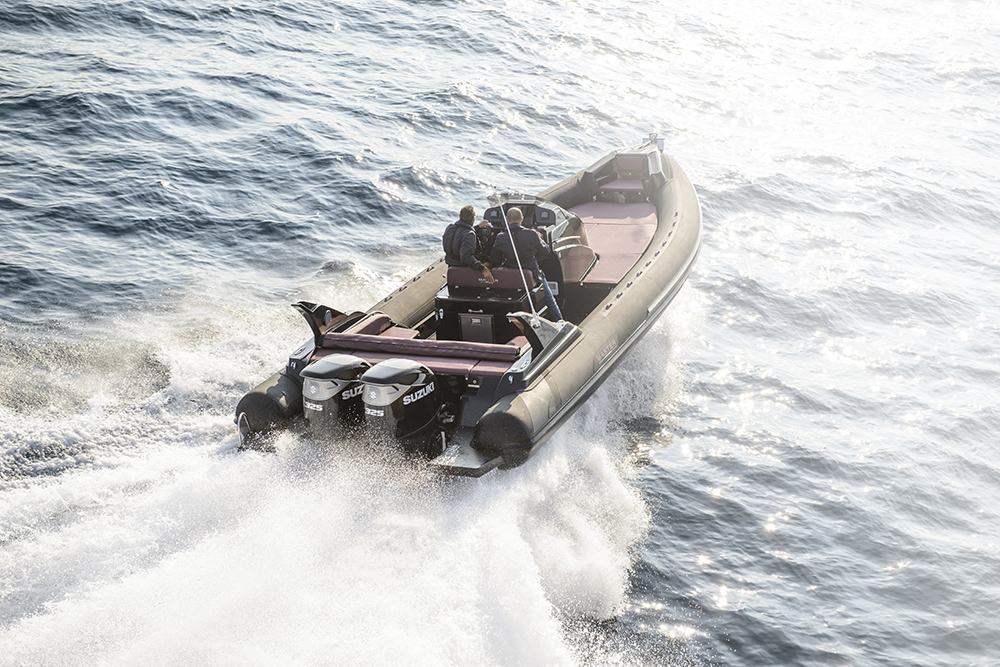
In other aspects, this will be much the same engine as the DF350. Both engines use an offset driveshaft (as with all Suzuki V6s) where the power head is moved slightly further forward, benefitting fore and aft trim. However, the real work is in the gearbox. The benefit of having two smaller-diameter propellers instead of one bigger one is that the bevel gears required to turn these props can be smaller. This means a smaller and sleeker gear case to house these gears, and importantly less drag as a result. Though the propellers are smaller in diameter, they have a greater surface area, which, with their equalising counterrotation effect, gives them a high level of hydrodynamic grip, which during mid-range power delivery exceeds a single-propeller engine.
Suzuki DF325 technical specifications
| Specification | Detail |
| Shaft lengths | X: 635mm (25″); XX: 762mm (30″) |
| Starting system | Electric |
| Engine type | V6 – 55° DOHC 24-valve |
| Weight | X: 330kg (727lb); XX: 339kg (747lb) |
| Valve train drive | Chain with variable valve timing |
| Fuel delivery system | Electronic fuel injection |
| No. of cylinders | 6 |
| Displacement | 4.390 litres (267.9 cu.in.) |
| Bore x stroke | 98mm x 97mm (3.74″ x 3.82″) |
| Max. output | 325hp / 239.0kW |
| Full-throttle operating range | 5300-6300 rpm |
| Alternator | 12V / 54A |
| Gear ratio | 2.29:1 |
For more information on Suzuki and their engines, visit:

Greg Copp
Technical Editor | Powerboat & RIB