Advertisement

Navan Boats website banner saying Boundless Versatility on the Water
MDL Marinas advertising MPU saying 'Out of Office' Switch off, Cast off, Save this summer
  • Navan Boats website banner saying Boundless Versatility on the Water
  • Nordkapp Noblesse 720 ad banner - Explore the Noblesse 720

Suzuki DF350 review: Twin-prop V6 outboard tested on a Brig Eagle

Greg Copp reviews the Suzuki DF350, a 350hp twin-prop V6 outboard tested on a 10m Brig Eagle, examining its acceleration, grip, engineering and technical specification.
28 Feb

Edited February 28, 2018

Powerboat and RIB

Content by Greg Copp

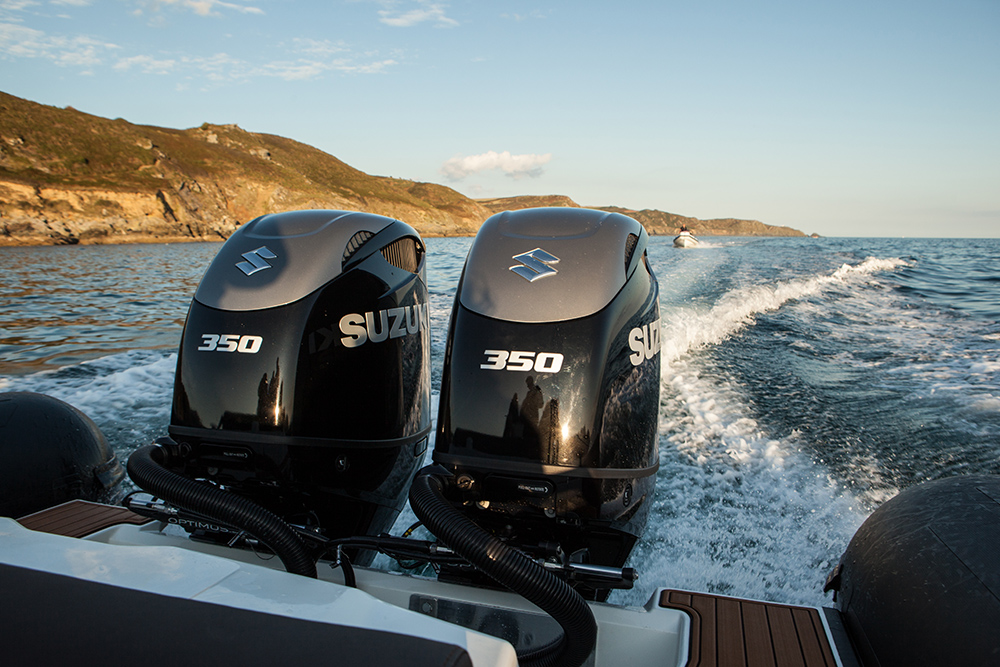
Twin Suzuki 350 outboards powering a RIB along a rocky coastline at speed

Share this Article

Suzuki DF350 review - twin-prop performance on the water

Greg Copp takes a closer look at the DF350 from Suzuki

Nothing quite beats the adrenaline rush of nailing the throttles on two big outboard engines. It was not just the twin 350hpDF350s driving the 10m Brig Eagle, but the grip these engines had on the water. When it comes to turning torque into knots, two propellers are always better than one for low- and mid-range power delivery, and Suzuki’s new twin engines are not shy in coming forward in this department, as they sharply pick up from as low as 2000rpm, with one of the broadest power deliveries I have experienced. The hole shot performance was outstanding, especially considering these engines had 3300kg of boat to contend with.

This is a beautifully smooth engine, and pretty quiet at half-sensible speeds. But of course, its real nature, the one for which it was built, is a different one. Once you hit 4800rpm it develops what can only be described as a ‘demonic howl’ when the variable valve timing advances fully, enabling this high-compression engine to truly come on song. The engine tone is addictive, and like nothing I have heard before. Although it has plenty going for it below this point, from 4800rpm to a 6300rpm redline this engine has a manic power delivery that grips you like it does the water.

It truly excels in its punching out of tight turns, making it hard to drive in a straight line. If you are not careful, these motors will have you against the sponsons at the flip of a wheel. There is no discernible slip as the stern tracks round, kept in line by the grip of four props. I kept my feet widely spaced, wedged against the console while standing – any other stance and the kill cord might have done its job. Twin-prop grip is nothing new, as Volvo Penta and MerCruiser have shown with their sterndrive engines over the years. However, when applied in a dual rig in something light and rakish like a RIB, the concept takes on a new dimension.

Why the Suzuki DF350 twin-prop outboard matters

Many of you will ask the question: why has it taken until now for somebody to build an outboard with counter-rotating props? In answer to that, I will put the record straight, as Yamaha built the first twin-prop outboard in the form of the 150hp V4 V-Max back in the 90s – a very capable 2-stroke engine that proved popular, mainly in the US, but was discontinued for no good reason. I have in the past presented the idea of a twin-prop outboard engine to various outboard manufacturers, to which I generally got a shrug of the shoulders. I suspect that cost in the form of expensive R&D has been a factor, especially given that outboard engine prices have risen considerably in the last decade, and pricing is a key competing point. Also, in terms of top-end performance, single-prop engines can deliver on a par with twin-prop motors, especially as most speed junkies have twin rigs with counter-rotating propellers.

High-compression V6 engineering and fuel delivery

Looking beneath the skin, the DF350 is an impressive beast. It is a stroked DF300 block, insomuch as Suzuki have taken a DF300 and lengthened the stroke by 8mm, which has increased the capacity by 362cc to 4.4L. Increasing capacity and lengthening the stroke will boost torque, but they have also increased the compression ratio to 12:1. The issue here is pre-ignition or ‘pinking’. A compression ratio of 10:1 is considered a safe limit at which pinking will not occur for the average engine running on 95 octane petrol. However, modern fuel injection systems, safeguarded by an ECU with a pre-ignition sensor, retarding the ignition in the event of pinking, can comfortably push this margin to 11:1. The more you squeeze an air/fuel mixture, the more effectively it combusts, and consequently more energy and torque are produced – hence improved efficiency. Pushing the envelope to 12:1 with 95 octane fuel takes some doing, and this is where the team at Suzuki have done their homework.

No production outboard has yet been built to run at 12:1, especially as fuel quality varies around the world. However, Suzuki appear to have achieved this through several simple but effective engineering improvements, the most significant being the use of two injectors instead of one. This means that the fuel can be injected in one pulse from two opposing injectors into the combustion chamber. The main advantage is better atomisation, as with fuel entering the combustion chamber from two locations, fuel molecules can bond more effectively with air molecules – meaning less unburnt fuel. With the fuel injected at once rather than in a stratified pulse, there is a slight local cooling effect, which reduces the possibility of pre-ignition. Another interesting feature is the dual-louvre air intake system. In principle it is simple, using dog-leg inlet passages on both sides of the cowling with louvres (slanted panels) to trap and drain off water droplets. It is claimed this removes all moisture while reducing the induction temperature. Exactly how it reduces the temperature has not been explained, but a cooler air charge is a denser charge, with more air molecules for any given capacity. More molecules means better atomisation. In theory, maximum efficiency is achieved at a ratio of 14.7 molecules of air to 1 of petrol. However, many engines run at 13:1, as 14.7:1 creates a risk of pre-ignition with damaging results. What is certain is that a cooler air charge will improve torque and efficiency.

Cooling, intake and internal strength

Not surprisingly, Suzuki have beefed up the engine internals using uprated ‘shot-peened’ pistons to take the extra power. The engine also has a separate forced air cooling system to remove the heat radiated from the cylinder block. This operates through an intake on the starboard side of the cowling drawing in fresh air. This is circulated by the fan on the flywheel before exhausting through a port-side vent.

Drive train, gearcase and twin-prop grip

All these advances in the powerhead will mean nothing without a drive train and a propulsion set-up to take it. Firstly, by using an offset drive shaft (as with all Suzuki V6s), the powerhead is moved slightly further forward, benefitting fore and aft trim, while enabling a reduction gear of 2.29:1. However, the real work not surprisingly is in the gearbox. The benefit of having two smaller-diameter propellers instead of one bigger one is that the bevel gears required to turn these props can be smaller. This means a smaller and sleeker gear case to house these gears, and importantly, less drag as a result. Though the propellers are smaller in diameter, they have a greater surface area, which with their equalising counter-rotation effect gives them a high level of hydrodynamic grip.

Advertisement

Navan Boats website banner saying Boundless Versatility on the Water

Suzuki DF350 weight, rivals and verdict

Weighing in at 330kg, it sits between the 303kg 2.8L straight-6 350hp supercharged Mercury Verado and the 346kg 5.3L V8 350hp naturally aspirated Yamaha F350, so some may consider it a tad overweight. However, for the average boater this is splitting hairs, and as a single installation the advantages of twin props really can’t be ignored. The true judge of it will be how it stacks up against the opposition, which in due course will become apparent.

Fuel figures for the DF350 fitted to the Brig Eagle are shown in the Brig feature in this issue.

Suzuki DF350 technical specifications

SpecificationDetail
Shaft lengthsX: 638mm (25″); XX: 762mm (30″)
Starting systemElectric
Engine typeV6 – 55° DOHC 24-valve
WeightX: 330kg (727lb); XX: 339kg (747lb)
Valve train driveChain with variable valve timing
Fuel delivery systemElectronic fuel injection
No. of cylinders6
Displacement4.390 litres (267.9 cu.in)
Bore x stroke98mm x 97mm (3.74″ x 3.82″)
Maximum output350hp / 257.4kW
Full throttle operating range5700-6300 rpm
Alternator12V / 54A
Gear ratio2.29:1
Powerboat and RIB

Greg Copp

Technical Editor | Powerboat & RIB

Advertisement

Navan Boats website banner saying Boundless Versatility on the Water
MDL Marinas advertising MPU saying 'Out of Office' Switch off, Cast off, Save this summer
  • Navan Boats website banner saying Boundless Versatility on the Water
  • Nordkapp Noblesse 720 ad banner - Explore the Noblesse 720

You might also like