Back to Basics – Part 1: The ‘COLREGs’

Paul Glatzel begins a new back-to-basics series with a clear, practical guide to COLREGs, explaining how skippers can assess risk and avoid collisions on busy waterways.
02 Jan

Edited January 2, 2024

Powerboat and RIB

Content by Paul Glatzel

Powerboat and RIB

Share this Article

Back to Basics: Essential boating knowledge

In this series of articles, Paul Glatzel takes us back to what you might call ‘the essentials of boating’. In the pages of PBR we host an amazing array of boats, but there’s no point having a great powerboat if you don’t know how to use your chartplotter and understand the charts they are built on so you can safely go to all the fun and interesting places. You’ll have to appreciate how tides affect you and the best place to find the appropriate information. And of course, in any waterway – and especially the busy ones – you must know how to avoid collisions with other craft and what the rules are that you need to apply.

While this series of articles is aimed primarily at those starting out, we’re sure that even the pros among you will learn a thing or two during this series. We hope that you enjoy it. This article is also of great use for those considering the RYA Powerboat Level 2 as a boating course.
Avoiding collisions at sea

So let’s start with avoiding collisions. The rules around this tend to be referred to as the COLREGs. They are pretty simple, and for me, one of the really key ways to keep you and those you boat with safe is to work as a team on board.

Yes, the buck stops with you as skipper, but engage your crew and especially the kids. Youngsters are brilliant and love pointing out the presence of other craft that may present a risk of collision – keep them busy and keep them keen!

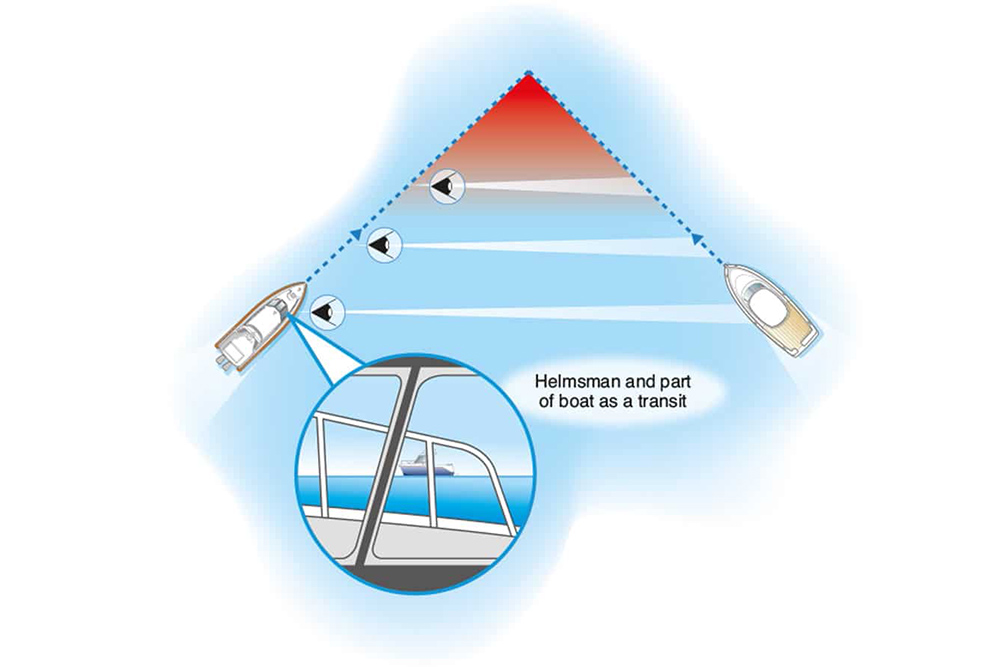
Diagram showing risk of collision, illustrating how another vessel remains aligned despite distance.

Assessing risk of collision

The rules you would learn as part of a boating course start with the message that they always apply to us all, and that we must do everything in our power to avoid a collision. They make clear that there’s no such thing as a ‘right of way’, and that whatever the rules say, the moment it looks like there could be a collision you need to be ready to take appropriate action.

So, what would a Powerboat Level 2 course teach you? Obviously you need to keep a proper lookout so you can detect other craft. Yes, of course, this will mean using your eyes, but don’t forget to use your ears too, as so often in busy locations you pick up many close vessels through sound.

Use your crew as well – tell them to alert you to moving craft and consider using the clock face: for example, ‘windsurfer, fast left to right at your 10 o’clock’.

If you have radar, then in certain situations you’ll be obligated to use it. Realistically, however, while at first glance radar may look simple, it actually isn’t as easy as it looks, so if you have one, do a course so you fully understand its use and potential.

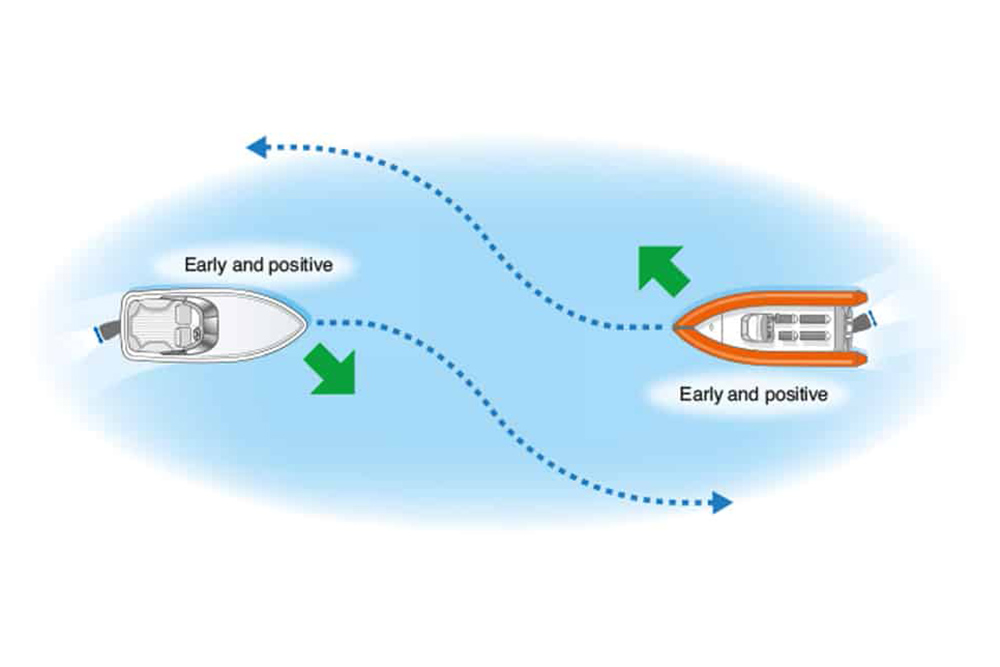
Head-on collision avoidance diagram showing two powerboats altering course early to starboard under COLREGs rules.
Head-On

Advertisement

  • Pantaenius insurance advertising banner with No Nonsense, Get a Quote, No policy cancellation fees, No policy admin fees, no monthly instalment fees.
  • Boatfests 2026 advert

Safe speed and head-on situations

When we’re out there on the water we need to choose a safe speed so that we can always react in time to a potential collision situation. Many factors could influence what a safe speed is, but the obvious ones are simple – the number of craft around, weather and sea conditions, depth of water, etc.

In harbours or estuaries there may be speed limits, but beyond those areas it’s all about safe speed and you being able to justify the speed that you were doing.

As we spot other vessels, we need to determine whether they present a risk of collision. If a vessel remains on a constant bearing to us, whether ahead of us or coming from our left or right, there’s a risk of collision.

In reality, we rarely tend to take an actual bearing but just line up a couple of points on our boat with the other craft. If this line stays the same, we are heading for a crash and must apply the rules to avoid a collision. (See collision diagram)

Crossing situations explained

We then need to consider what sort of vessel we are facing, which will determine what we need to do. If it’s a power-driven craft, there are some specific rules we need to follow. If it’s anything else – such as a vessel under sail, a kayak, a vessel constrained by its draught, or a vessel restricted in its ability to manoeuvre – we need to give way to them.

The rules are not clear on how we should do this, so generally we turn to the right (starboard), unless that takes us into danger. It also makes sense to slow down. Reducing speed buys you time and reduces the chance of a collision.

Crossing situation diagram showing give-way powerboat altering course to starboard while the stand-on vessel maintains course and speed.
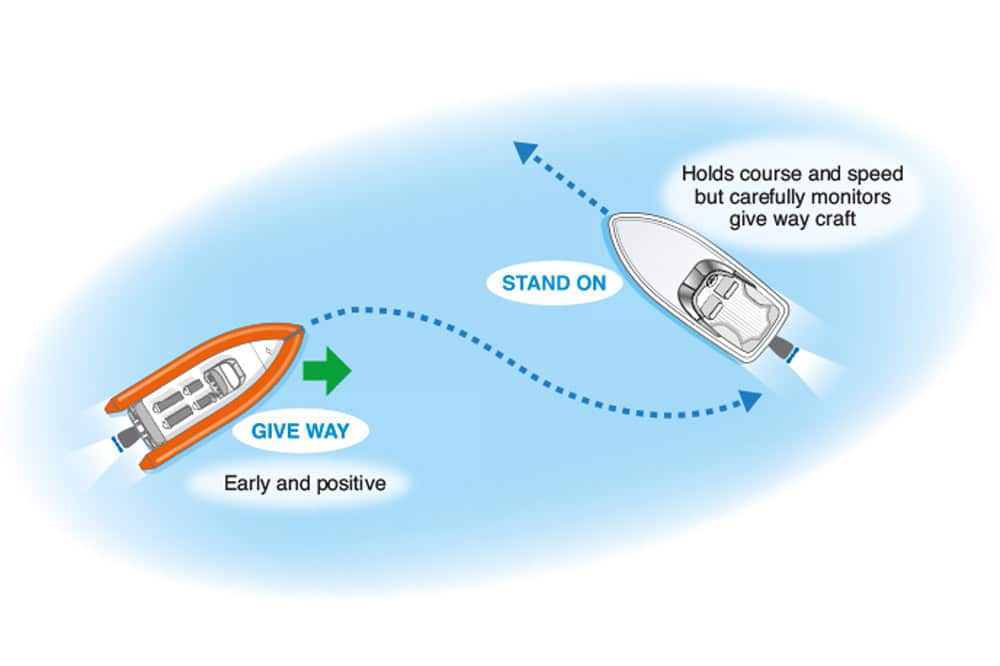
Crossing: The give-way craft needs to turn to the right (starboard) to pass behind the stand-on vessel.

For power-driven vessels there are two key situations.

Head-on.

If we are ‘head-on’ to another power-driven vessel (‘PDV’), both craft are termed ‘give-way’ and both must make early and obvious turns to the right. (See head-on diagram)

Crossing situation. If a PDV is approaching from between (roughly) your 12 and 4 o’clock, your vessel is the ‘give-way’ one. The other craft is ‘stand-on’ and needs initially to hold course and speed. However, those on the stand-on boat need to keep a really good eye on the give-way one to ensure it does what it needs to. The give-way craft needs to turn to the right (starboard) to pass behind the stand-on one. (See crossing diagram)

Overtaking

The final situation to have a look at is ‘overtaking’. This is where power-driven and sailing vessels can fall out. So often we hear that ‘power gives way to sail’ and most of the time that’s true. It’s the ‘overtaking’ situation where things are different, though.

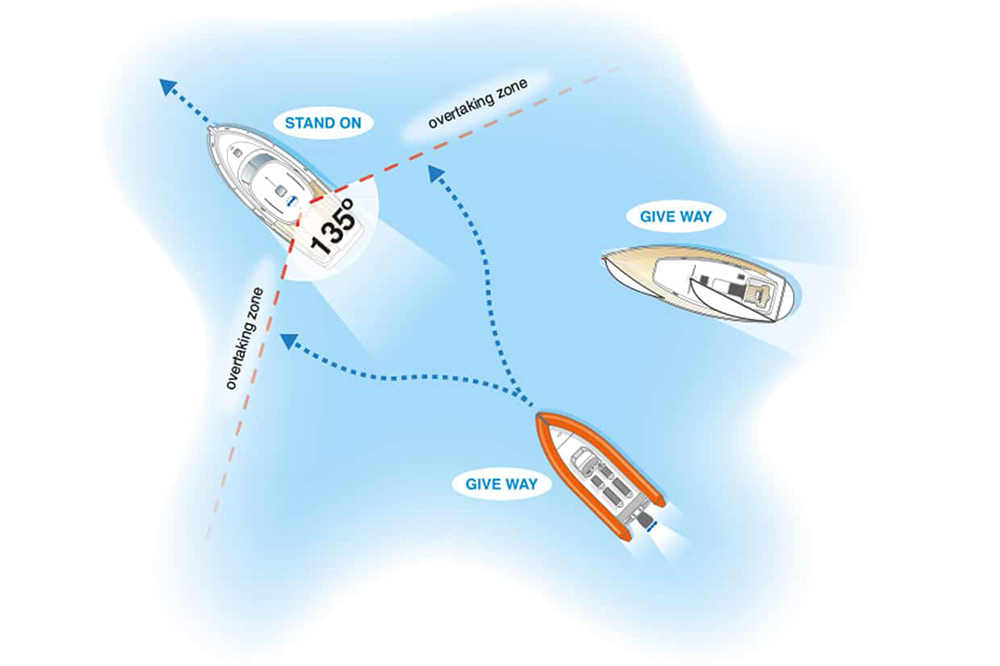
If a boat is approaching from between roughly your 4 and 8 o’clock, they are ‘give-way’ and you are the ‘stand-on’ vessel. The overtaking craft can pass on either side and must be careful to get well past you before they cut back in front of you.

If you think about it, it’s logical that if a sailing vessel is overtaking you, they are give-way. They are faster and know which side they can go, so it makes sense that they are the give-way craft. So power doesn’t always give way to sail! (See overtaking diagram)

Overtaking rules diagram showing a stand-on vessel ahead and give-way craft approaching from astern within the 135-degree overtaking sector.
Overtaking: The overtaking craft can pass on either side and must be careful to get well past you before they cut back in front of you.

Advertisement

Nordkapp_MPU_Dec25

COLREGs summary and key safety advice

In summary, the rules are pretty straightforward, but you need to know them and apply them. The single most important action you can take is to slow down.

Many collisions occur because a skipper is uncertain what’s happening and has little time to make a decision. Slow down, buy yourself time, and stay safe.

Keep safe and have a great time afloat!

Further reading and viewing

Check out Powerboat and RIB TV, where Paul Glatzel and TMS discuss all aspects of getting afloat.


The RYA Powerboat Handbook and RYA Advanced Powerboat Handbook are available in print or as e-books from Amazon or the RYA shop at rya.org.uk/shop.

Powerboat and RIB

Paul Glatzel

Tuition Writer | RYA Instructor | Author of RYA Powerboat Handbooks | Powerboat & RIB

Advertisement

Nordkapp_MPU_Dec25
  • Pantaenius insurance advertising banner with No Nonsense, Get a Quote, No policy cancellation fees, No policy admin fees, no monthly instalment fees.
  • Boatfests 2026 advert
South Coast & Green Tech boat show advert showing Book your free tickets

You might also like